

Contents
A common rule, set out in the French wiring standard NF C 15-100, is that wires should fill no more than one third of a conduit's inner cross-section. The free space lets you pull the wires without damaging them and lets heat escape. In practice, 16 mm suits a lighting circuit, 20 mm a socket circuit, and 25 to 32 mm larger or grouped circuits. Always check against the real outer diameter of your wire, given on the cable manufacturer's datasheet.
How do you apply the one-third rule?
Compare the space the wires take with the space inside the conduit. You need two figures:
- d: the outer diameter of one wire, insulation included, from the cable maker's datasheet;
- D: the inner diameter of the conduit.
The one-third rule then reads: number of wires ≤ D² ÷ (3 × d²).
Note that the number used to name a conduit (16, 20, 25 mm) usually refers to its outer diameter. The inner diameter is smaller by the thickness of both walls. Measure it on a sample with callipers before you calculate.
Worked example. According to Nexans' datasheet for its H07V-U MOBIWAY POP wire, the maximum outer diameter is 3.2 mm for a 1.5 mm² conductor and 3.9 mm for 2.5 mm². Take a conduit with a measured inner diameter of 13 mm (an example value; use your own measurement):
- 1.5 mm² wire: 13² ÷ (3 × 3.2²) = 169 ÷ 30.7 ≈ 5.5, so 5 wires at most;
- 2.5 mm² wire: 13² ÷ (3 × 3.9²) = 169 ÷ 45.6 ≈ 3.7, so 3 wires at most.
Three 2.5 mm² wires (line, neutral, earth) only just fit. For a socket circuit, or to add a wire later, go up one size. For a multi-core cable, use its overall outer diameter as d.
NF C 15-100 is a French standard. It is often used as a reference on building sites, but it is not legally binding in the DRC. Follow your project specification and your electrician's advice.
Other codes use different limits: the US NEC allows 40% fill for three or more wires, and British practice uses cable-factor tables. The one-third rule is the more conservative of these and leaves room for pulling.
Rigid, flexible, spiral or HDPE: which goes where?
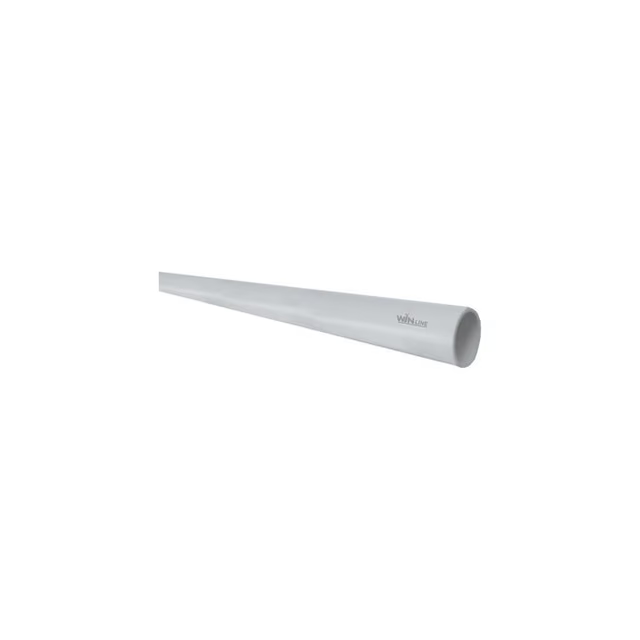
- Rigid PVC conduit (3 m lengths): for straight, surface-mounted runs on walls and ceilings. It is fixed with clips and joined with elbows and couplings.
- Flexible conduit: for concealed runs inside walls and partitions. It bends by hand, so you need fewer fittings. To embed conduit in a concrete slab you need a type rated for it (ICTA under NF C 15-100): ask us for the datasheet before you order.
- Spiral conduit (25 m coils): it is supple, follows curves and covers long runs in one piece.
- HDPE conduit (coils sold in yards): high-density polyethylene is common for long runs and outdoor links, including buried ones. Check the datasheet to confirm the conduit you choose is suitable for burial. When burying conduit, standard practice is to lay a warning mesh above it.
Which Winline conduit for which circuit?
MK Energies & Services is an authorised Winline dealer in Kinshasa. Lighting: 16 mm; sockets: 20 mm; grouped circuits or large cables: 25–32 mm. These are the main families, with figures from our product sheets:
| Family | References | Diameters | Pack | Colour |
|---|---|---|---|---|
| Grey rigid PVC conduit, Heavy series | WN-PVC1618, 2018, 2518, 3219 | 16, 20, 25, 32 mm | 3 m length | Grey |
| White rigid PVC conduit | WN-PVC16W, 20W, 25W, 32W | 16, 20, 25, 32 mm | 3 m length | White |
| Black flexible conduit | WN-F10B, F16B, F20B | 10, 16, 20 mm | 50 yards (≈ 46 m) | Black |
| Blue flexible conduit | WN-R2540B, R2840B, R3240B, R4040B | 25, 28, 32, 40 mm | 50 yards (≈ 46 m) | Blue |
| Spiral PVC conduit | WN-COR13G-1, WN-COR16B | 13, 16 mm | 25 m | Black |
| Beta HDPE conduit | WN-TS1990, WN-TS2390 | 19, 23 mm | 90 yards (≈ 82 m) | Orange/grey |
The range goes further: a second, standard grey rigid series, WN-PVC16G to WN-PVC32G (16 to 32 mm, 3 m lengths), grey flexible conduit from 13 to 28 mm and red from 25 to 40 mm, grey spiral conduit up to 32 mm, orange/grey Beta HDPE from 13 to 23 mm in 30-, 45- or 90-yard coils and 29 mm in 30-yard coils, and orange Alpha HDPE from 13 to 23 mm. See all rigid conduits and all flexible conduits.
Colours help you tell circuits apart on site, for example one colour for power and another for data or telephone lines.
Which couplings, elbows and clips should you use?
Always match the fitting to the conduit diameter. Winline offers four PVC families in 16, 20, 25 and 32 mm:
- conduit-to-box couplings WN-FG16 to WN-FG32, for a clean entry into a box;
- PVC connectors WN-CON16 to WN-CON32, to join two lengths of conduit end to end;
- PVC elbows WN-ELB16 to WN-ELB32, for changes of direction;
- PVC clips WN-CLP16 to WN-CLP32, to fix the conduit to the wall.
A ready-made elbow keeps a smooth bend, so the wires slide more easily when you pull them. The full range is on the fittings and accessories page. For boxes, pick a junction box suited to the location: our guide to IP ratings helps you choose for outdoor or damp areas. Winline PVC conduit junction boxes come in 20 and 25 mm (1- to 4-way, T, U and Y), for example the 20 mm T box WN-P2004.
Should you use trunking instead of conduit on surface runs?
Yes, if you want to add cables later without taking everything apart. Trunking fixes to the surface and has a removable lid. Winline mini trunking runs from 15 × 10 to 40 × 20 mm in 3 m lengths, with or without adhesive backing. Larger trunking goes up to 100 × 60 mm. Choose a size that leaves room for future cables. See our cable trunking.
Delivery and quotes
We deliver within Kinshasa and to other provinces of the DRC. Give the delivery location in your quote request. The full range is on our Winline page and the catalogue is on the Downloads page. Our showroom is at No. 26, Avenue des Huileries, Gombe, opposite the INRB.
Ask for a quote on WhatsApp at +243 903 005 060 with the references, diameters and quantities (number of lengths or coils). Price on request.
Frequently asked questions
How many wires fit in a 20 mm conduit?
About 8 × 1.5 mm² wires or 5 × 2.5 mm² wires, for an inner diameter of 16 mm (an example value; measure your own conduit). The result depends on your conduit and wire: apply D² ÷ (3 × d²) with your own measurements (Nexans datasheet: 3.2 mm for 1.5 mm², 3.9 mm for 2.5 mm²). A corrugated flexible conduit usually has a smaller inner diameter than a smooth rigid one of the same nominal size: at 14 mm inside, you drop to 4 × 2.5 mm² wires.
16 mm or 20 mm flexible conduit?
Lighting circuits in 1.5 mm² commonly use 16 mm conduit, and 2.5 mm² socket circuits use 20 mm. When in doubt, take the larger size: pulling is easier and you keep room for later. ICTA and IRL are French conduit classes (corrugated flexible, smooth rigid); our Winline product sheets do not state such a rating, so check the datasheet before embedding conduit in concrete.
Is a conduit's size its inner or outer diameter?
The nominal figure usually refers to the outer diameter. The one-third rule needs the inner diameter, so measure it on a sample.
Can several circuits share one conduit?
The one-third calculation still applies, but grouped circuits make the wires run hotter. Have your electrician check the wire cross-section. A 25 or 32 mm conduit gives you headroom. Two rules apply in every case: never run power cables and telephone or data cables in the same conduit, and keep all the conductors of one circuit (line, neutral, earth) in the same conduit.
Sources: Nexans product sheets for H07V-U MOBIWAY POP 1 × 1.5 mm² and 1 × 2.5 mm² (maximum outer diameter 3.2 mm and 3.9 mm respectively); NF C 15-100 for the one-third rule; Winline product sheets from our catalogue.
A question?
Our team answers on WhatsApp or through the contact form.
Products mentioned
- Reference
- WN-PVC1618
- Size
- 16 mm
- Length
- 3 m
Price on request
- Reference
- WN-PVC2018
- Size
- 20 mm
- Length
- 3 m
Price on request
- Reference
- WN-PVC2518
- Size
- 25 mm
- Length
- 3 m
Price on request
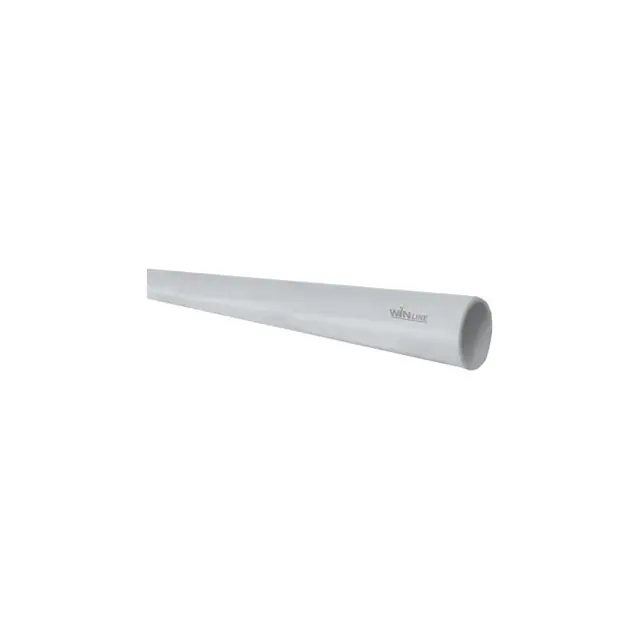
- Reference
- WN-PVC3219
- Size
- 32 mm
- Length
- 3 m
Price on request
Related categories