

Contents
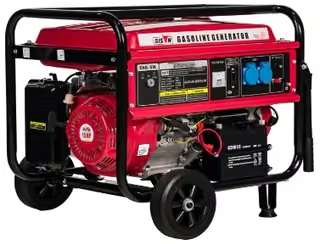
Our four Bison open-frame petrol (gasoline) generators are rated at 2.0, 2.8, 5.0 and 7.0 kW. The two smaller ones, the BS2500H and the BS3500H, have an aluminium-wound alternator and a recoil start. The BS6500H (5 kW) and the BS8500H (7 kW) have copper winding, an electric start, wheels and a 25 L tank.
What are the specifications of the four models?
All four generators are single-phase 220 V / 50 Hz, with a single-cylinder, four-stroke engine. The table shows the values from our datasheets.
| Model | Rated / max power | Engine | Displacement | Winding | Start | Tank | Weight | Dimensions |
|---|---|---|---|---|---|---|---|---|
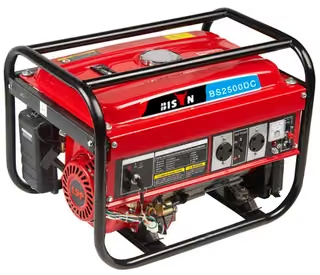
| BS2500H | 2.0 / 2.3 kW | 170F | 210 cc | aluminium | recoil | 15 L | 38 kg | 61 × 44 × 44 cm |
| BS3500H | 2.8 / 3.0 kW | 170F | 210 cc | aluminium | recoil | 15 L | 40 kg | 61 × 44 × 44 cm |
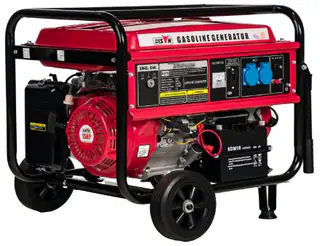
| BS6500H | 5.0 / 5.5 kW | 190F | 420 cc | copper | electric | 25 L | 82 kg | 69 × 53 × 56 cm |
| BS8500H | 7.0 / 7.5 kW | 192F | 458 cc | copper | electric | 25 L | 90 kg | 69 × 53 × 56 cm |
Each product page gives the full details and the PDF datasheet: Bison BS2500H, Bison BS3500H, Bison BS6500H and Bison BS8500H.
How much power do your appliances need?
Compare your appliances with the rated power, not the maximum power. The rated power is what the generator delivers continuously. The maximum power is only available for short periods. On these models it is just 7 to 15% above the rated power (for example 5.5 kW against 5.0 kW for the BS6500H), while a motor started direct-on-line can draw about three times its running power, which is why our finder calculates the start separately.
With our finder's default values, five lights (500 W), a refrigerator (300 W), a television (120 W) and a computer (200 W) draw 1,120 W while running. The refrigerator, however, draws far more current when it starts than when it runs.
Appliances with a motor therefore set the generator size: refrigerator, freezer, water pump (1,100 W by default) and air conditioner (1,500 W by default). Our guide on what size generator a house needs works through two examples with figures. For your own appliances, use the finder to work out your generator size.
Copper or aluminium winding: what is the difference?
The winding is the wire coiled inside the alternator, where the current is produced. Copper and aluminium do the same job there, with different properties.
| Property | Copper | Aluminium |
|---|---|---|
| Electrical conductivity | about 58 MS/m | about 35 to 38 MS/m (60 to 65% of copper's) |
| Density | 8.96 g/cm³ | 2.70 g/cm³ |
| Volumetric heat capacity | about 3.45 J/(cm³·K) | about 2.42 J/(cm³·K) |
What this means in practice:
- Copper conducts better. At the same cross-section, an aluminium wire runs hotter for the same current. So aluminium needs a thicker wire to do the same job.
- Copper copes better with heat and overloads. It heats less for the same current and absorbs more heat before the wire insulation reaches its limit. This matters when the generator runs for long periods close to its rated power, or in a hot room.
- Copper is easier to repair. A copper winding is straightforward to rewind and solder. Aluminium connections oxidise and need more care.
- Aluminium is lighter and cheaper. It suits occasional use, as long as the load stays within the rated power.
The Bison datasheets give no further detail on the alternator. The weight gap between the models also comes from the engine and the frame: a 420 cc engine weighs more than a 210 cc one. In our open-frame petrol range, the winding follows the power: aluminium up to 2.8 kW, copper at 5 and 7 kW. The datasheets of our inverter generators do not state the winding material.
Recoil or electric start?
A recoil starter is a cord you pull sharply. It needs no battery and is very simple. It takes some effort, especially if you start the generator several times a day.
An electric starter is operated from the generator's control panel and runs on a battery. It makes a 420 or 458 cc engine easier to start, since these are harder to crank by hand than a 210 cc engine. If the generator stands unused for several weeks, check the battery charge regularly so it starts at the next power cut.
Want an electric start below 5 kW? The Bison BS3500iS inverter generator (3.1 kW) has an electric start and a remote start. At 5 kW, the Bison BS6250iE inverter generator (5.0 kW, 47 kg, 11 L tank) also has electric and remote start.
Tank and weight: what changes?
The two smaller models have a 15 L tank and weigh 38 to 40 kg. Plan on two people to carry them. The 5 and 7 kW models have a 25 L tank and weigh 82 to 90 kg. Their datasheets list wheels and a handle for moving them.
The footprint follows the same pattern: 61 × 44 × 44 cm for the smaller models, 69 × 53 × 56 cm for the larger ones. Check that you have the space before you buy.
For comparison, the Bison BS3500iS weighs 23 kg for 3.1 kW, with a 4 L tank. The BS3500H weighs 40 kg for 2.8 kW, with a 15 L tank. At 5 kW, the BS6250iE weighs 47 kg with an 11 L tank, compared with 82 kg and 25 L for the BS6500H.
Running time on a full tank depends on the load; the datasheets of these four models do not state it. Always run the generator outdoors, in a well-ventilated spot: exhaust gases contain carbon monoxide.
Can a petrol generator run for long periods?
Yes, within its rated power, which it delivers continuously. You will need to refuel regularly (15 L or 25 L tank), and our datasheets do not give fuel consumption. A petrol generator is still designed for occasional use: for several hours of running every day, compare it with a diesel set in our diesel, petrol or inverter comparison.
Where can you see these generators in Kinshasa?
All four models belong to our Bison range. MK Energies & Services is an authorised Bison dealer in Kinshasa, DRC. You can see them at our showroom in Gombe, No. 26, Avenue des Huileries, opposite the INRB. We also deliver to other provinces of the DRC. We handle installation, maintenance, after-sales service and spare parts: see our services.
Ask for a quote on WhatsApp: open the page of the model you want among our petrol generators and tap the WhatsApp button. The message opens pre-filled with the product name. You can also message +243 903 005 060. Prices on request.
Frequently asked questions
Is a 5 kW petrol generator enough for a house?
For lights, a refrigerator, a television and a computer, yes: with our finder's default values these draw 1,120 W while running, well below the 5.0 kW continuous output of the Bison BS6500H. An air conditioner or a pump draws far more current when it starts: run the numbers in the finder before you choose. At 5 kW, you can choose between the open-frame BS6500H (82 kg, 25 L) and the BS6250iE inverter generator (47 kg, 11 L).
What is the difference between the BS6500H and the BS8500H?
The power and the engine: 5.0 kW and 420 cc for the BS6500H, 7.0 kW and 458 cc for the BS8500H. The BS8500H weighs 90 kg, compared with 82 kg for the BS6500H. Both have copper winding, an electric start, a 25 L tank and the same dimensions.
Is an aluminium winding a bad choice?
No. It suits occasional use within the rated power. Copper copes better with heat and overloads, and it is easier to repair.
Are these petrol generators single-phase?
Yes. All four models deliver single-phase 220 V / 50 Hz. If you need three-phase power, read our guide on single-phase or three-phase generators.
Sources: manufacturer datasheets (Bison), MK Energies & Services finder default values, standard physical properties of copper and aluminium.
A question?
Our team answers on WhatsApp or through the contact form.
Products mentioned
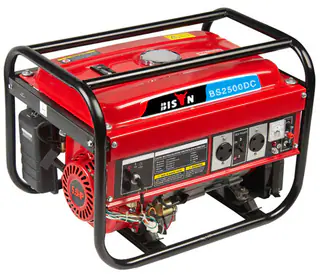
- Engine
- 170F
- Displacement
- 210 cc
- Starting
- Recoil
- Fuel tank
- 15 L
- Open frame
- Portable
- Air-cooled
Price on request
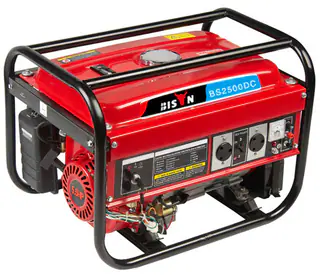
- Engine
- 170F
- Displacement
- 210 cc
- Starting
- Recoil
- Fuel tank
- 15 L
- Open frame
- Portable
- Air-cooled
Price on request
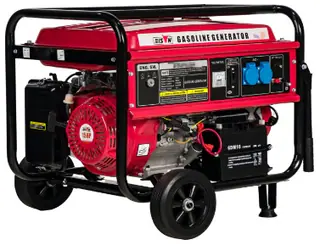
- Engine
- 190F
- Displacement
- 420 cc
- Starting
- Electric
- Fuel tank
- 25 L
- Open frame
- Portable
- Air-cooled
Price on request
- Engine
- 192F
- Displacement
- 458 cc
- Starting
- Electric
- Fuel tank
- 25 L
- Open frame
- Portable
- Air-cooled
Price on request

Related categories