

Contents
For a Kinshasa house with lighting, a fridge, a freezer, TVs, a computer, a 1.1 kW pump and a 1.5 kW air conditioner, our finder works out a need of about 8.3 kVA: the air conditioner's start-up sets the generator size. With an inverter air conditioner, the need drops to about 4.75 kVA if the pump also has a soft start. The smallest suitable generator is then a 9.4 kVA set in the first case and a 5 kVA set in the second. If the pump starts direct-on-line, allow about 7.2 kVA, which means an 8 kVA set.
How much power do household appliances use?
Our finder's default values range from 100 W for a light to 1,500 W for an air conditioner; they are cautious values. Appliances with a motor draw far more current when they start than when they run, so they set the generator size.
| Appliance | Default power | Motor |
|---|---|---|
| Lighting (per light) | 100 W | no |
| Refrigerator | 300 W | yes |
| Freezer | 400 W | yes |
| Television | 120 W | no |
| Computer | 200 W | no |
| Water pump | 1,100 W | yes |
| Air conditioner | 1,500 W | yes |
Check the rating plate on your own appliances, which gives the actual power.
Example 1: a house with a standard air conditioner
A house with a standard air conditioner, started direct-on-line, needs about 8.3 kVA, for a total load of only 4.34 kW. The gap comes from the air conditioner's start-up.
The appliances in the example:
- 6 lights, 100 W each
- 1 refrigerator, 300 W
- 1 freezer, 400 W
- 2 televisions, 120 W each
- 1 computer, 200 W
- 1 water pump, 1,100 W
- 1 air conditioner, 1,500 W
The calculation follows the lines our finder displays:
| Calculation line | Working | Result |
|---|---|---|
| Total connected load | sum of the appliances | 4.34 kW |
| Simultaneous use (×0.7) | 4.34 × 0.7 | 3.04 kW |
| Apparent power (÷ PF 0.8) | 3.04 ÷ 0.8 | 3.80 kVA |
| + 25% reserve | 3.80 × 1.25 | 4.75 kVA |
| Largest motor start (1.5 kW ×3) | 1.5 ÷ 0.8 = 1.88 kVA, then × 3 | 5.63 kVA surge |
| Step-load requirement (+10%) | (3.80 − 1.88 + 5.63) × 1.1 | 8.30 kVA |
| Required capacity | the larger of 4.75 and 8.30 | 8.3 kVA |
Values rounded to two decimals; the finder shows one.
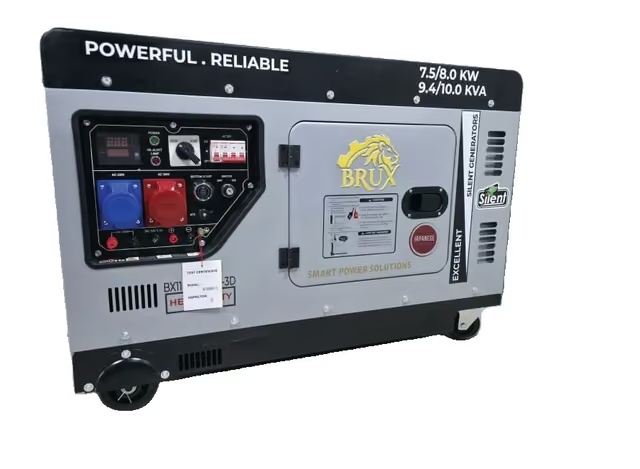
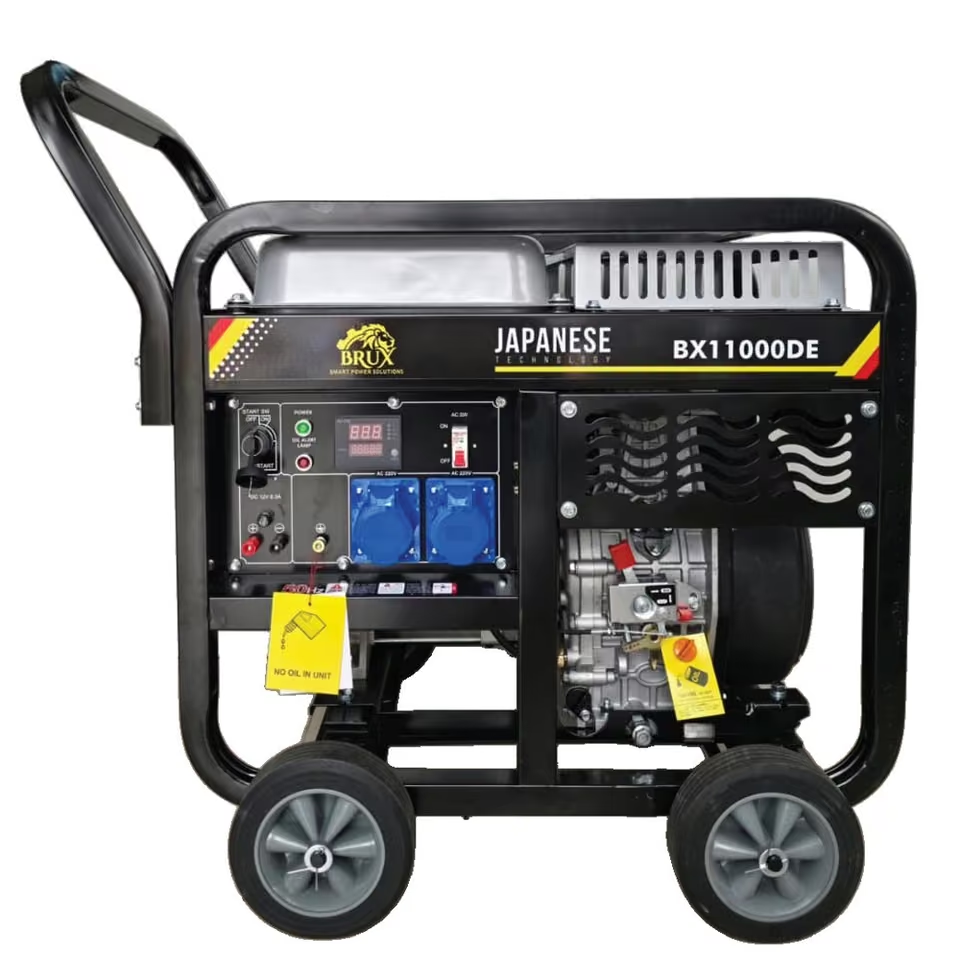
For a single-phase supply, the smallest set in our range that covers 8.3 kVA is the Brux BX11000DE (9.4 kVA, open frame). An open-frame set must be installed under shelter, in a ventilated room. If your house has a three-phase supply, the Brux BX11000DSE3-3D (9.4 kVA, silent) is suitable. On three-phase, each phase supplies only about a third of the rating, 3.1 kVA here, so an electrician must spread the circuits across the three phases. The air conditioner's start-up draws about 5.6 kVA on its single phase, so have our team confirm this choice. See our guide single-phase or three-phase. You can also browse all our silent diesel generators and open-frame diesel generators.
Example 2: the same house with an inverter air conditioner
With an inverter air conditioner, the same house needs about 4.75 kVA if its pump also has a soft start, about 40% less. In the finder, an inverter air conditioner's gradual start matches the "VFD" start method, with a factor of 1.2 instead of 3.
The first four lines of the calculation stay the same: 4.34 kW, 3.04 kW, 3.80 kVA and 4.75 kVA. Only the start-up changes:
| Calculation line | Working | Result |
|---|---|---|
| Largest motor start (1.5 kW ×1.2) | 1.88 × 1.2 | 2.25 kVA surge |
| Step-load requirement (+10%) | (3.80 − 1.88 + 2.25) × 1.1 | 4.59 kVA |
| Required capacity | the larger of 4.75 and 4.59 | 4.75 kVA |
Here the 25% reserve sets the generator size, not the start-up.
With the 1.1 kW pump started direct-on-line, its start-up sets the size: (3.80 − 1.38 + 4.13) × 1.1 ≈ 7.2 kVA, which means the Bison BS11000DSE (8 kVA, single-phase).
If the pump also has a soft start, three 5 kVA single-phase sets in our range are suitable:
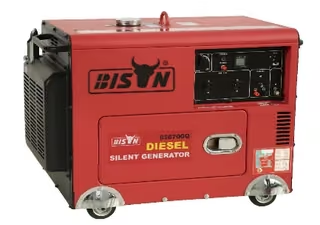
- the Bison BS7500DSE, a 5 kVA silent diesel;
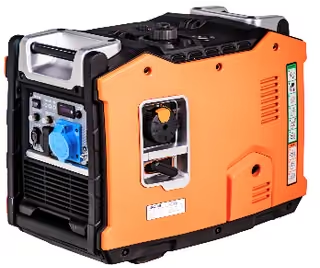
- the Bison BS6250iE, a 5 kW petrol inverter;
- the Bison BS6500H, a 5 kW petrol set.
Petrol sets are rated in kW, which the finder counts as kVA to stay on the safe side: our guide kVA vs kW explains the difference.
Examples worked out with the finder's method; final sizing is confirmed by our technical team.
Pumps, water towers and boosters: what do they change?
A 1.1 kW water pump started direct-on-line needs about 4.5 kVA on its own: as with the air conditioner, its start-up matters more than its running power. Our finder's working for this pump alone, entered as a total load (Method B): 1.1 ÷ 0.8 = 1.38 kVA running; on a direct start, 1.38 × 3 = 4.13 kVA, or 4.54 kVA with the 10% margin.
The finder checks the start-up of the largest motor only, here the air conditioner, while the other appliances keep running. If your air conditioner is an inverter model but your pump starts direct-on-line, do the calculation with the pump as the largest motor, or ask our team.
To raise the water pressure from the mains or a tank, you use an automatic booster pump. See our booster pumps and our guide Which water pump for a house in Kinshasa?.
How is this calculation done?
The finder adds up your appliances, allows for simultaneous use, converts to kVA, adds a reserve and checks the start-up of the largest motor. Use it to work out your generator size with your own appliances.
Single-phase or three-phase at home?
Most houses have a single-phase supply, and a single-phase generator suits them. If your house has a three-phase supply or a three-phase pump, choose a three-phase set.
Work out the size of your own generator
To work out your generator size, enter your appliances and how many of each you have. The finder then lists the suitable models and prepares your quote request.
For business premises, see our worked examples for a shop, a clinic and a workshop.
Frequently asked questions
Can I power my whole house with a small generator?
Yes, if you limit what runs at the same time. The finder's "Simultaneous use" setting shows the effect: "Low (×0.6)" reduces the load taken into account.
Is an oversized generator a problem?
Yes. It costs more to buy and to run. A diesel set that runs for long periods at very low load, below about 30%, burns its fuel incompletely and builds up carbon deposits. So avoid heavy oversizing.
Is the finder's result final?
No. It is a first estimate. Our technical team confirms the final sizing with you before you buy.
Sources: manufacturers' datasheets (Bison and Brux generators), MK Energies & Services finder calculation method.
A question?
Our team answers on WhatsApp or through the contact form.
Products mentioned
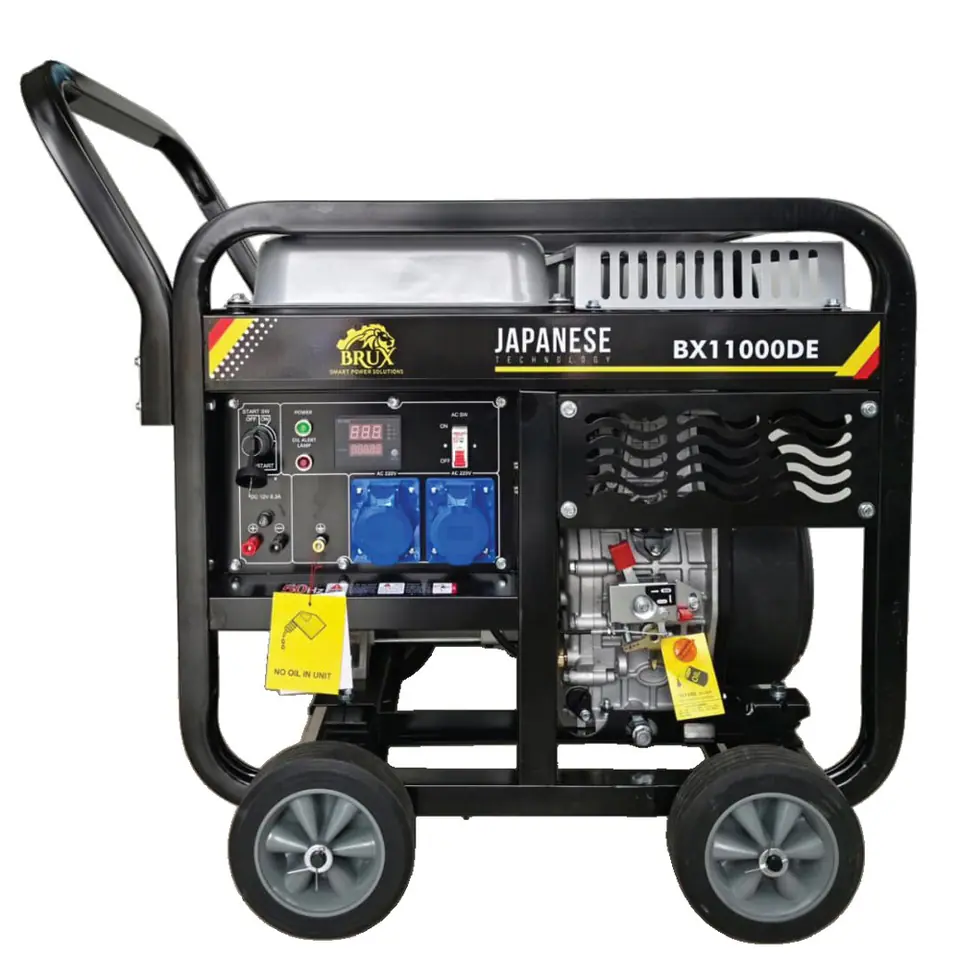
- Engine
- Diesel 688FG
- Voltage
- 220 V, single-phase, 50 Hz
- Starting
- Electric
- Equipment
- 36 Ah battery, 5-in-1 digital display
- Open frame
- Air-cooled
Price on request
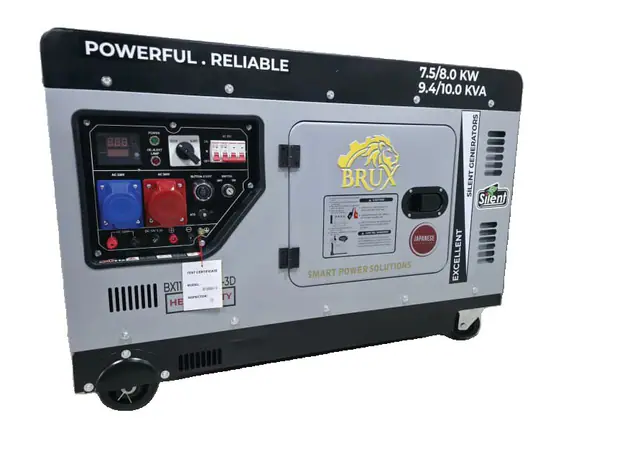
- Engine
- Diesel 688FG
- Voltage
- 220/380 V, three-phase (balanced), 50 Hz
- Starting
- Electric and remote
- Equipment
- 36 Ah battery, 5-in-1 display, ATS socket
- Air-cooled
Price on request
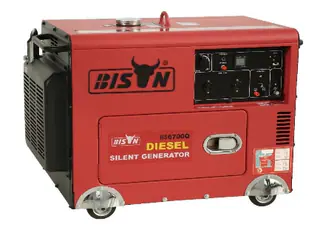
- Engine
- 188FA
- Voltage
- 220 V, 50 Hz
- Starting
- Electric
- Fuel tank
- 12.5 L
- Air-cooled
Price on request
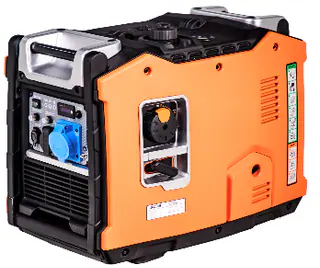
- Fuel tank
- 11 L
- Starting
- Electric
- Harmonic distortion (THD)
- <2%
- Sound level
- 67 dB
- Air-cooled
Price on request
Related categories