

Contents
All nine 150cc motorcycles we sell in Kinshasa share the same spec sheet: a single-cylinder, air-cooled, four-stroke 162FMI-E engine, 8.6 kW at 8,500 rpm, a top speed of at least 85 km/h, fuel consumption of 2.3 L/100 km, an 11.5 L tank and a 150 kg maximum load. They differ by brand, version and colour. Based on these figures, a full tank covers about 500 km.
Here are the values shared by all nine spec sheets, as listed on our product pages:
| Specification | Value (spec sheet) |
|---|---|
| Displacement | 150 cc |
| Engine | Single-cylinder, air-cooled, 4-stroke (162FMI-E) |
| Bore × stroke | 62 × 49.9 mm |
| Compression ratio | 9.3:1 |
| Max. power | 8.6 kW at 8,500 rpm |
| Max. torque | 10.2 N·m at 7,000 rpm |
| Top speed | ≥ 85 km/h |
| Fuel consumption | 2.3 L/100 km |
| Fuel tank | 11.5 L |
| Max. load | 150 kg |
| Brakes | Front disc / rear drum |
| Tyres | Front 2.75-18 / rear 3.00-18 |
| Ground clearance | 165 mm |
| Wheelbase | 1,280 mm |
| Dimensions | 1,980 × 750 × 1,020 mm |
| Starting | Electric / kick |
| Ignition | CDI |
What do displacement, power and torque tell you about a 150cc motorcycle?
Displacement is the volume the piston sweeps. A 62 mm bore and a 49.9 mm stroke give about 150.7 cc (π/4 × 6.2² × 4.99 cm), rounded to 150 cc. In the usual naming of this engine family, the "1" in 162FMI means one cylinder and the "62" is the bore in millimetres.
Maximum power is 8.6 kW, or about 11.5 hp. The engine only reaches it at 8,500 rpm, near the top of the rev range. Power sets the top speed, which the spec sheet gives as at least 85 km/h.
Torque, 10.2 N·m at 7,000 rpm, is the engine's twisting force; through the gearbox and chain it becomes pulling force at the rear wheel. It is what you feel pulling away from traffic lights, climbing a hill or carrying a passenger. To keep good pick-up, stay in the rev range where the engine pulls well and shift down before it labours.
A 9.3:1 compression ratio is typical for an air-cooled four-stroke of this size. Air cooling means no radiator, coolant or water pump, so there are fewer parts on the bike.
How much fuel does a 150cc motorcycle use, and how far does a tank go?
The spec sheet gives 2.3 L/100 km. With an 11.5 L tank, that is about 500 km per fill. The table shows the fuel needed for different daily distances, based on that figure.
| Distance per day | Fuel per day | Days per 11.5 L tank |
|---|---|---|
| 50 km | 1.15 L | 10 days |
| 100 km | 2.3 L | 5 days |
| 150 km | 3.45 L | about 3 days |
This is a spec sheet figure, not a measurement in traffic. In Kinshasa traffic, with frequent stops, a passenger or luggage, real consumption is usually higher. Correct tyre pressure, a well-adjusted chain and smooth riding help you stay close to the spec sheet value.
To measure your own consumption, fill the tank, note the odometer reading, ride, then fill up again. Divide the litres added by the kilometres covered and multiply by 100.
Load, brakes and tyres: what matters for motorcycle-taxi use?
Maximum load: 150 kg. As a rule, this total includes the rider, the passenger and any luggage. A 75 kg rider and a 70 kg passenger already add up to 145 kg. Above the rated load, braking distances grow and the tyres, chain and shock absorbers wear faster.
Brakes: disc at the front, drum at the rear. On a motorcycle the front wheel does most of the braking, hence the disc. The rear drum is simple and shielded from mud. Use both brakes, especially when loaded.
Tyres: 2.75-18 front, 3.00-18 rear. The first number is the tyre width in inches (about 70 mm and 76 mm). The second, 18, is the rim diameter in inches. It is a common size on motorcycles of this class. The wider rear tyre carries most of the load.
Ground clearance: 165 mm. This is the distance between the ground and the lowest point of the motorcycle. It matters on unpaved roads, speed bumps and kerbs.
Why do all nine models have the same spec sheet?
Because, according to their spec sheets, they share the same mechanical base. Every specification line is identical across the nine spec sheets. What changes is the brand, the version name and the listed colour.
| Brand | Version | Model | Colour (spec sheet) |
|---|---|---|---|
| Toyama | Classic | TY150CL | Red |
| Toyama | Premium | TY150PR | Red |
| Toyama | Plus | TY150PS | Red |
| Brux Motos | Express | BR150EX | Black |
| Brux Motos | Business | BR150BS | Black |
| Simba | Simba Green | Z150GR | Green |
| Simba | Simba Brown | Z150BR | Brown |
| Volcan | Volcan Red | X150RD | Red |
| Volcan | Volcan Blue | X150BL | Blue |
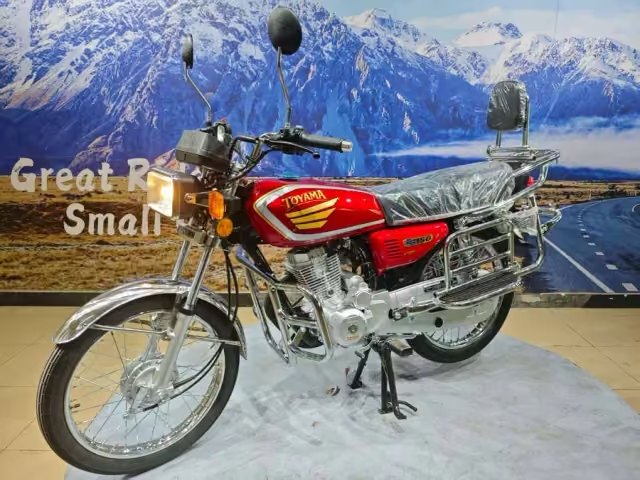
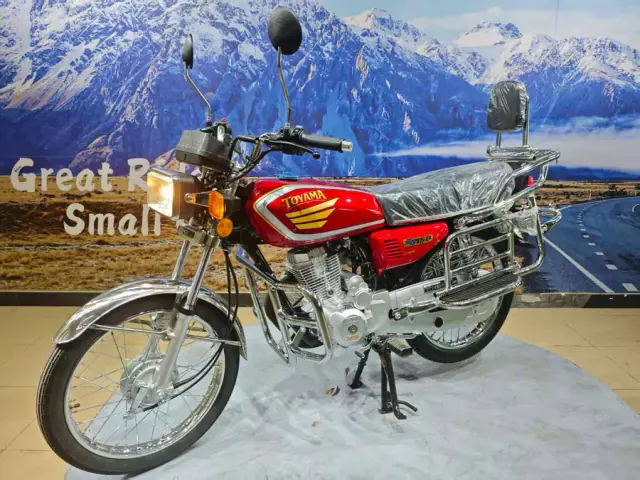
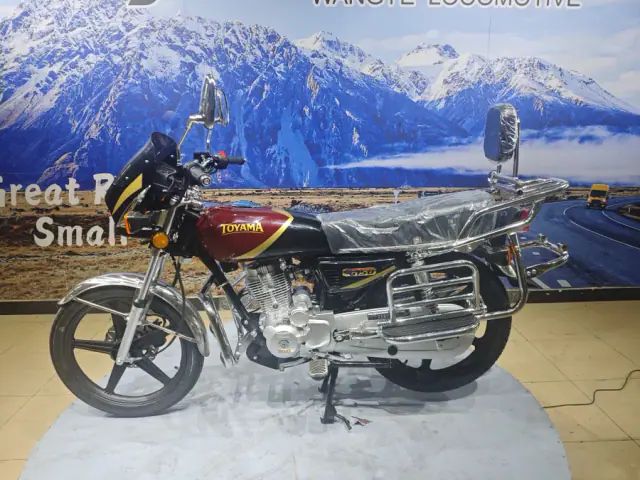
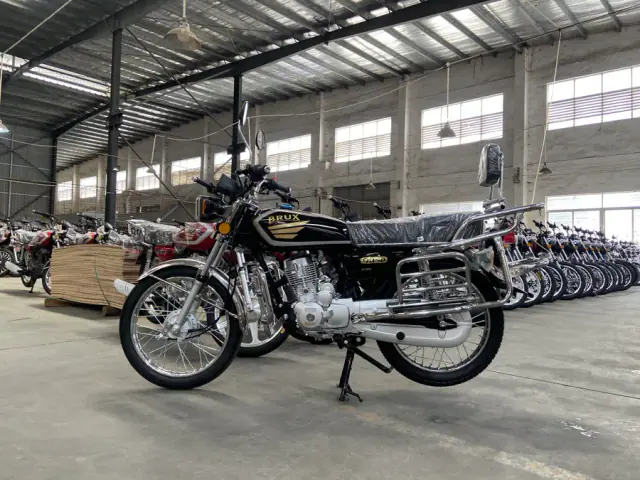
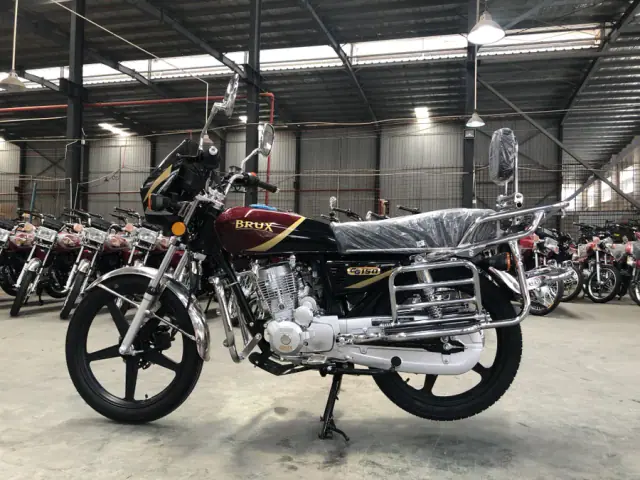
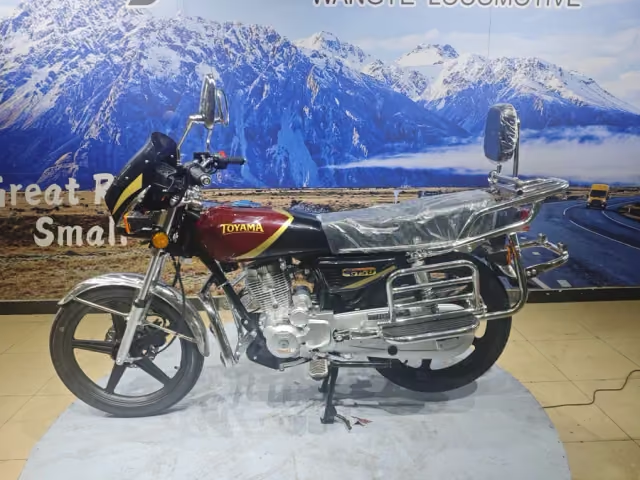
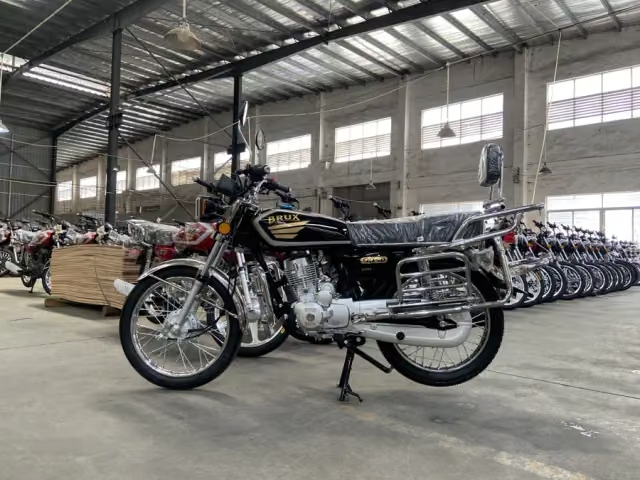
The spec sheets list no technical difference between versions. For the finish, equipment and look of each version, see the photos on its page (and its video, where there is one), or come and see it at the showroom. The full range is on our Motorcycles page.
Electric start, kick start and CDI ignition: what are they for?
Electric start turns the engine over at the press of a button, using the battery. It is convenient when you start and stop the engine dozens of times a day.
Kick start is the foot-operated starting lever. It is the backup when the battery is weak. Having both on the same bike means you are not left stranded.
CDI ignition (capacitor discharge ignition) fires the spark plug electronically, without mechanical contact breaker points. There are no points to adjust, and starting stays consistent.
Where can you see these motorcycles in Kinshasa?
In business in Kinshasa since 2010, MK Energies & Services is an authorized dealer for Toyama, Brux Motos, Simba and Volcan. You can see our motorcycles at our showroom: No. 26, Avenue des Huileries, Centre des Handicapés, opposite the INRB, Gombe. It is open Monday to Friday from 8 am to 5 pm and Saturday from 11 am to 4 pm. Contact us before you visit to check which models are available. We also deliver to the other provinces of the DRC.
Ask for a quote on WhatsApp: open the page of the motorcycle you want and tap the WhatsApp button, or message +243 903 005 060. Tell us the brand, version and quantity. Price on request.
Frequently asked questions
How far does a 150cc motorcycle go on a full tank?
About 500 km, based on our motorcycles' spec sheets: an 11.5 L tank at 2.3 L/100 km. In city traffic with a passenger, expect less.
What is the difference between a Toyama, a Brux, a Simba and a Volcan 150cc?
According to their spec sheets, none mechanically: same 162FMI-E engine, same performance, same load rating, same brakes and tyres. They differ by brand, version and colour.
What is the 162FMI engine?
A 150cc single-cylinder, air-cooled, four-stroke engine with a 62 mm bore. On our motorcycles, the 162FMI-E version produces 8.6 kW at 8,500 rpm and 10.2 N·m at 7,000 rpm.
Can a 150cc motorcycle carry two people?
The maximum load on the spec sheet is 150 kg, which as a rule includes the rider. A 75 kg rider and a 70 kg passenger already make 145 kg: two adults only just fit within that limit, with no margin for luggage. Check the total before loading.
Sources: spec sheets of the Toyama, Brux Motos, Simba and Volcan 150cc motorcycles published on our product pages; range calculations based on those values.
A question?
Our team answers on WhatsApp or through the contact form.
Products mentioned
- Colour
- Red
- Engine
- 150 cc · 8.6 kW
Price on request
- Colour
- Red
- Engine
- 150 cc · 8.6 kW
Price on request
- Colour
- Black
- Engine
- 150 cc · 8.6 kW
Price on request
- Colour
- Black
- Engine
- 150 cc · 8.6 kW
Price on request
Related categories