


Contents
Short answer
- Which oil? For a Perkins-engine generator, a 15W-40 in API category CI-4, or CH-4. It meets the requirements of every Perkins document cited in this guide. Your engine’s manual remains the reference: if it says otherwise, follow it.
- When to change it? Oil and filter every 500 service hours or once a year, according to the 2012 Perkins manuals cited below, with an oil level check every day. Check the interval in your engine’s manual.
- How much? The quantity is on your generator’s data sheet; for our Perkins-engine generators, see the capacity table below. Always top up by the dipstick.
- No manual? Send us a photo of the engine plate on WhatsApp at +243 903 005 060.
No, Kinshasa’s heat does not mean you have to move to 20W-50. This guide is based on six Perkins documents, listed at the end; four of them give a viscosity table. All four tables allow 15W-40, from −10 to 50 °C ambient temperature. Of these documents, only the older data sheets of the 1103A-33G and 1103A-33TG2 engines, which power our 30 and 60 kVA generators, list 20W-50: from about −5 to 50 °C, the same upper heat limit as 15W-40.
What do “15W-40” and “20W-50” mean on an oil can?
They are two viscosity grades from the SAE J300 standard. The number before the W, for “winter”, rates how the oil behaves at a cold start. The number after the dash rates its viscosity at engine operating temperature, measured at 100 °C.
The higher the numbers, the thicker the oil. A 20W-50 is therefore thicker than a 15W-40 when hot, and flows less easily at a cold start: on the older Perkins data sheets, its band starts at about −5 °C, against −10 °C for 15W-40.
Thicker does not mean better: the engine maker sets the allowed grades.
What do the Perkins documents say?
Each document sets two things: the minimum API category and the grades allowed for each ambient temperature. Here is what the four Perkins documents with a viscosity table say about the two grades.
| Perkins document | Engine | API category required | SAE 15W-40 | SAE 20W-50 |
|---|---|---|---|---|
| Technical data sheet TPD1488E (older, issue 1) | 1103A-33G, our 30 kVA generator | API CG-4 or CH-4 | −10 to 50 °C | about −5 to 50 °C |
| Technical data sheet TPD1490E (older, issue 1) | 1103A-33TG2, our 60 kVA generator | API CG-4 or CH-4 | −10 to 50 °C | about −5 to 50 °C |
| Operation and Maintenance Manual SEBU8325-01 (July 2012) | 1104D, not in our range | API CH-4 or CI-4 | −10 to 50 °C | not in the table |
| Operation and Maintenance Manual SEBU8311-03 (April 2012) | 400A and 400D industrial engines | API CH-4 multigrade, EMA DHD-1 multigrade or ACEA E5 | −10 to 50 °C | not in the table |
The newer Perkins data sheets, published in 2014 for the 1103A-33G and 1103A-33TG1 engines, have no viscosity table; they name a 15W-40 API CG-4 oil as the reference oil for their power ratings.
Is your engine in this table?
First read the engine plate: it gives the engine model, for example 1103A-33TG2. Up to 200 kVA, our Perkins-engine generators use 403A, 404A, 1103A, 1104A, 1104C and 1106A engines; our larger generators have other Perkins engines, which this guide does not cover.
- 1103A-33G and 1103A-33TG2 engines: the two data sheets in the table cover them directly.
- 403A and 404A engines, in our 13 to 20 kVA generators: they belong to the 400 series, but in a generator version; the manual in the table covers the 400A and 400D industrial versions.
- 1104D engine: an example only; it does not power any of our generators.
- Other engines (1103A-33TG1, 1104A, 1104C, 1106A, and those in our LEOMAX generators): no table in this guide covers them directly (for the 1103A-33TG1, the 2014 Perkins sheet PN1781A names a 15W-40 API CG-4 oil as its reference oil). Ask us for the engine documentation.
One limit of this guide: it was written without the Operation and Maintenance Manual for the 1103 and 1104 engines. Data sheets TPD1488E and TPD1490E also state that their information is given for guidance only. If your manual says otherwise, follow your manual.
Do you need 20W-50 for hot weather or an old engine?
If you are told to use 20W-50 “for the heat” or “for an old engine”, here is what the Perkins documents say.
| 15W-40 | 20W-50 | |
|---|---|---|
| Range on the older 1103A data sheets | −10 to 50 °C | about −5 to 50 °C |
| Perkins viscosity tables in this guide that allow it | 4 of 4 | 2 of 4 |
On the 1103A engines, 20W-50 is not a mistake
For the 1103A-33G and 1103A-33TG2 engines, in our 30 and 60 kVA generators, the older Perkins data sheets also allow 20W-50. If your technician put it in one of these generators, that is not an error. But 15W-40 in category CI-4 or CH-4 is the only one of the two grades that meets every Perkins document in this guide, these data sheets included.
Heat alone is not a reason
According to both 2012 manuals, the grade depends on two ambient temperatures: the lowest at a cold engine start and the highest during operation. On the 1103A data sheets, the 20W-50 band stops at 50 °C, like the 15W-40 band: it is not allowed at any higher temperature.
Monthly mean temperatures in Kinshasa range from 23.5 °C in July to 26.9 °C in March, according to the 1991 to 2020 normals of the Japan Meteorological Agency (JMA). In the afternoon, in the sun, inside a soundproof canopy or in a generator room, the air around the engine is hotter than these averages, but the 50 °C limit sits more than 23 °C above them. Keep the air inlets and outlets clear, and the room well ventilated.
An engine that runs hot or burns oil needs a diagnosis
The Perkins documents choose the grade by ambient temperature, not by the engine’s age or wear. Overheating and unusual oil consumption are symptoms to have diagnosed. Our guide to a generator that will not start, stalls or smokes black helps you describe the fault, and our team handles generator maintenance and repair.
How do you read the API category on the label (CI-4, CH-4, CF-4, SL)?
The API category tells you which engines the oil is formulated for. According to the American Petroleum Institute (API) guide, categories starting with C are for diesel engines and those starting with S are for petrol engines.
- CI-4, introduced in 2002, and CH-4, introduced in 1998, are current categories. API lists CG-4 and CF-4 as obsolete.
- According to API, a CI-4 oil can be used in place of CH-4, CG-4 or CF-4, and a CH-4 oil in place of CG-4 or CF-4. This is why a CI-4 oil also suits the documents that ask for CG-4 or CH-4.
- None of the four Perkins documents in the table allows a CF-4 oil: do not choose one for these engines.
- A dual label such as CI-4/SL covers a diesel category and a petrol category. When the C category comes first, the oil is formulated mainly for diesel engines.
- Recent engines with a particulate filter may require a newer category, such as CK-4, which API describes as suited to these systems. Again, the manual decides.
According to the Perkins manuals, an oil may carry the API symbol only with API’s authorisation: check for this symbol on the can when you buy.
Which diesel oils in our catalogue match these documents?
Our 15W-40 oils in category CI-4 match the four Perkins documents in the table, by the grade and category shown on the label or on our product page. Our 20W-50 CH-4 matches only the older data sheets of the 1103A engines.
| Oil in our catalogue | Grade | API category (label or product sheet) | Pack | 1103A-33G and 1103A-33TG2 data sheets | 1104D and 400 series manuals |
|---|---|---|---|---|---|
| Brux Lubricants SAE 15W-40 API CI-4 | 15W-40 | CI-4 | 20 L can | yes | yes |
| Brux Lubricants SAE 15W-40 API CI-4, drum | 15W-40 | CI-4 | 208 L drum | yes | yes |
| GP DeoGen Premium 15W-40 | 15W-40 | CI-4 (5 L), CI-4/SL (20 L) | 5 L and 20 L cans | yes | yes |
| GP DeoGen Standard 15W-40 | 15W-40 | two versions (CH-4 or CF-4), category confirmed in the quote | 208 L drum | yes if CH-4, no if CF-4 | yes if CH-4, no if CF-4 |
| GP DeoGen Standard 20W-50 API CH-4 | 20W-50 | CH-4 | 5 L can | yes | no: grade not in their table |
- A “yes” for a CI-4 oil against a document that asks for CG-4 or CH-4 relies on the API rule quoted above.
- This table compares the labels and our product sheets with the Perkins documents. It does not mean that Perkins has tested or approved these oils.
- The GP DeoGen Standard 15W-40 drum comes in two categories, CH-4 and CF-4. Check that the quote says CH-4: a CF-4 drum does not suit these engines.
Our diesel engine oils are intended for generators, trucks, construction machines and tractors. An oil sold for trucks suits a generator if its grade and category appear in the engine documentation. The full range is on our diesel engine oils page, with our other lubricants.
Can you switch from 20W-50 to 15W-40, or mix two oils?
Yes, you can change grade if the new grade appears in your engine documentation. Do it at a full oil change, with a new oil filter, and record the change in the maintenance log.
For a top-up, use the same oil. If you have to mix two brands, API advises keeping the same viscosity grade and the same API category. Topping up a 15W-40 sump with 20W-50 does not follow this advice.
The Perkins 1104D manual also gives three useful steps for the oil change:
- drain with the engine stopped but the oil warm, so that suspended particles drain out;
- do not fill the new filter before fitting it: that oil would not be filtered;
- keep the level between the MIN and MAX marks on the dipstick. Above MAX, the crankshaft can dip into the oil and make it foam, which reduces lubrication.
How much oil, and how often should you change it?
The quantity depends on the engine. Here is what our data sheets give for our Perkins-engine generators from 13 to 200 kVA:
| Generator (prime power) | Perkins engine | Oil capacity (our data sheet) |
|---|---|---|
| 13 kVA | 403A-15G1 | 6 L |
| 15 kVA | 403A-15G2 | 6 L |
| 20 kVA | 404A-22G1 | 10.6 L |
| 30 kVA | 1103A-33G | 8.3 L |
| 45 kVA | 1103A-33TG1 | 7.9 L |
| 60 kVA | 1103A-33TG2 | 8.3 L |
| 80 kVA | 1104A-44TG2 | 8 L |
| 100 kVA | 1104C-44TAG2 | 8 L |
| 135 kVA | 1106A-70TG1 | 16.5 L |
| 150 kVA | 1106A-70TAG2 | 16.5 L |
| 180 kVA | 1106A-70TAG3 | 16.5 L |
| 200 kVA | 1106A-70TAG4 | 16.5 L |
For a larger generator, ask us for its oil capacity. Our data sheets are in our catalogues and PDF data sheets.
Fill by the dipstick, not by the litre count alone. For the 1103A-33G, for example, the Perkins sheet TPD1488E gives 8.3 L for the whole system, and 6.2 L (minimum) to 7.8 L (maximum) in the sump.
Both 2012 Perkins manuals (1104D and 400 series engines) schedule an oil and oil filter change every 500 service hours or every year, and an oil level check every day. Check the interval in your own engine’s manual. For example, a generator running 8 hours a day during power cuts reaches 500 hours in just over two months.
High-sulphur diesel shortens this interval, according to the same manuals: 375 hours instead of 500 with 0.5 to 1% sulphur, and 250 hours above 1%. If you do not know the sulphur content of your diesel, ask your technician which interval to use.
The rest of the service plan (filters, coolant, belts) is in our generator maintenance guide. To find the engine model on a data sheet, see how to read a generator data sheet.
Frequently asked questions
Should you use 15W-40 or 20W-50 in a generator in Kinshasa?
For a Perkins-engine generator, a 15W-40 in API category CI-4 or CH-4: it is the only one of the two grades allowed by every Perkins document in this guide. Of these documents, only the older data sheets of the 1103A-33G and 1103A-33TG2 engines allow 20W-50. Your engine’s manual remains the reference.
Can you put petrol engine oil in a diesel generator?
Only if the label also carries the diesel category required by the engine documentation, as on a CI-4/SL oil. An oil that carries only an S category does not meet the diesel requirements of the Perkins documents.
Which oil for a small air-cooled diesel generator?
The one in the generator’s manual: our small air-cooled diesel generators, Bison and Brux, follow their maker’s manual, not the Perkins documents. Send us the generator model. These models are compared in our guide to silent diesel generators from 5 to 15 kVA, and the two cooling types in our guide to air-cooled or water-cooled generators.
How do you get the right oil for your generator?
Send us a photo of the engine plate and the hour meter reading, on WhatsApp at +243 903 005 060 or to info@mkenergies.com. We will tell you the grade, category and quantity of oil for your generator. Price on request. Delivery in Kinshasa and to the provinces. Showroom: No. 26, Avenue des Huileries, Gombe, Kinshasa.
Sources
All read on 24 November 2026. The Perkins documents are cited by their publication number.
- Perkins, Operation and Maintenance Manual, 1104D (Mech) Industrial Engine, SEBU8325-01, July 2012: “Engine Identification”, p. 18; “Fluid Recommendations”, pp. 33 to 36; “Maintenance Interval Schedule”, p. 50; “Engine Oil Level - Check”, p. 64; “Engine Oil and Filter - Change”, pp. 64 to 66.
- Perkins, Operation and Maintenance Manual, 400A and 400D Industrial Engines, SEBU8311-03, April 2012: “Fluid Recommendations”, pp. 41 to 44; “Maintenance Interval Schedule”, p. 60.
- Perkins, Technical Data 1103A-33G, TPD1488E, issue 1: “Lubrication system” and “Recommended SAE viscosity”.
- Perkins, Technical Data 1103A-33TG2, TPD1490E, issue 1: “Recommended SAE viscosity”.
- Perkins, 1103A-33G Diesel Engine, ElectropaK, PN1780, 2014.
- Perkins, 1103A-33TG1 Diesel Engine, ElectropaK, PN1781A, 2014.
- American Petroleum Institute, API’s Motor Oil Guide, 21 April 2025 edition: API motor oil guide (PDF)
- American Petroleum Institute, API Oil Categories: API oil categories
- STLE (Society of Tribologists and Lubrication Engineers), R. David Whitby, “Engine oil viscosity”, TLT magazine, undated PDF, for the definition of SAE grades: STLE article (PDF)
- FUCHS Lubricantes, S.A.U. (Spain), Viscosity charts, table “SAE J300 (Engine Oils)”, viscosities at 100 °C of the SAE 40 and 50 grades, undated page: FUCHS viscosity charts
- Japan Meteorological Agency (JMA), monthly normals 1991 to 2020 for Kinshasa, station 64210: JMA normals for Kinshasa; the 1991 to 2020 period is stated on the JMA normals index page (both pages in Japanese)
- MK Energies & Services: product pages for our diesel engine oils and PDF data sheets for our Perkins-engine generators.
A question?
Our team answers on WhatsApp or through the contact form.
Products mentioned
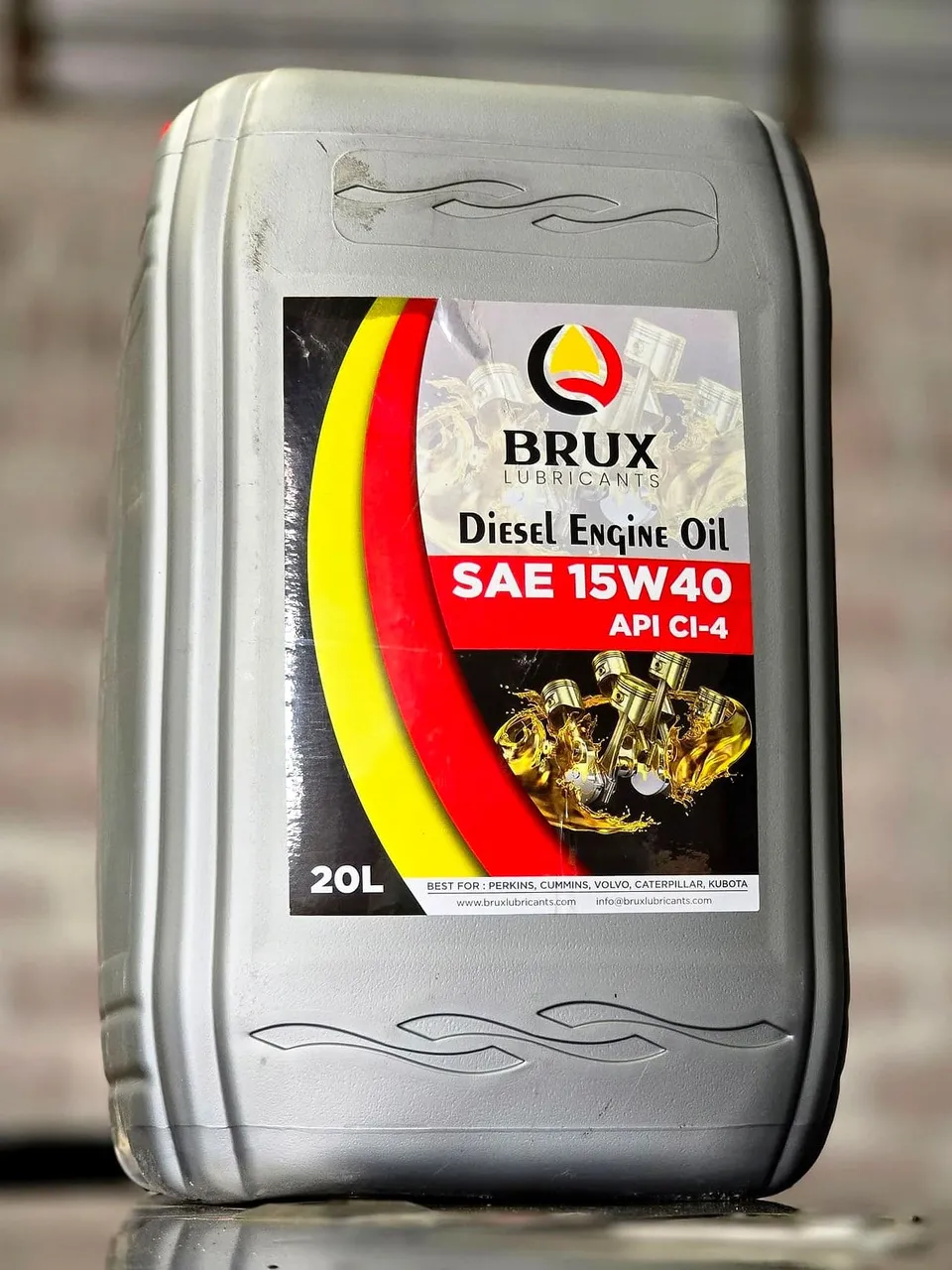
- Pack
- 20 L gallon (ref. BRUX 15W40 20L)
Price on request
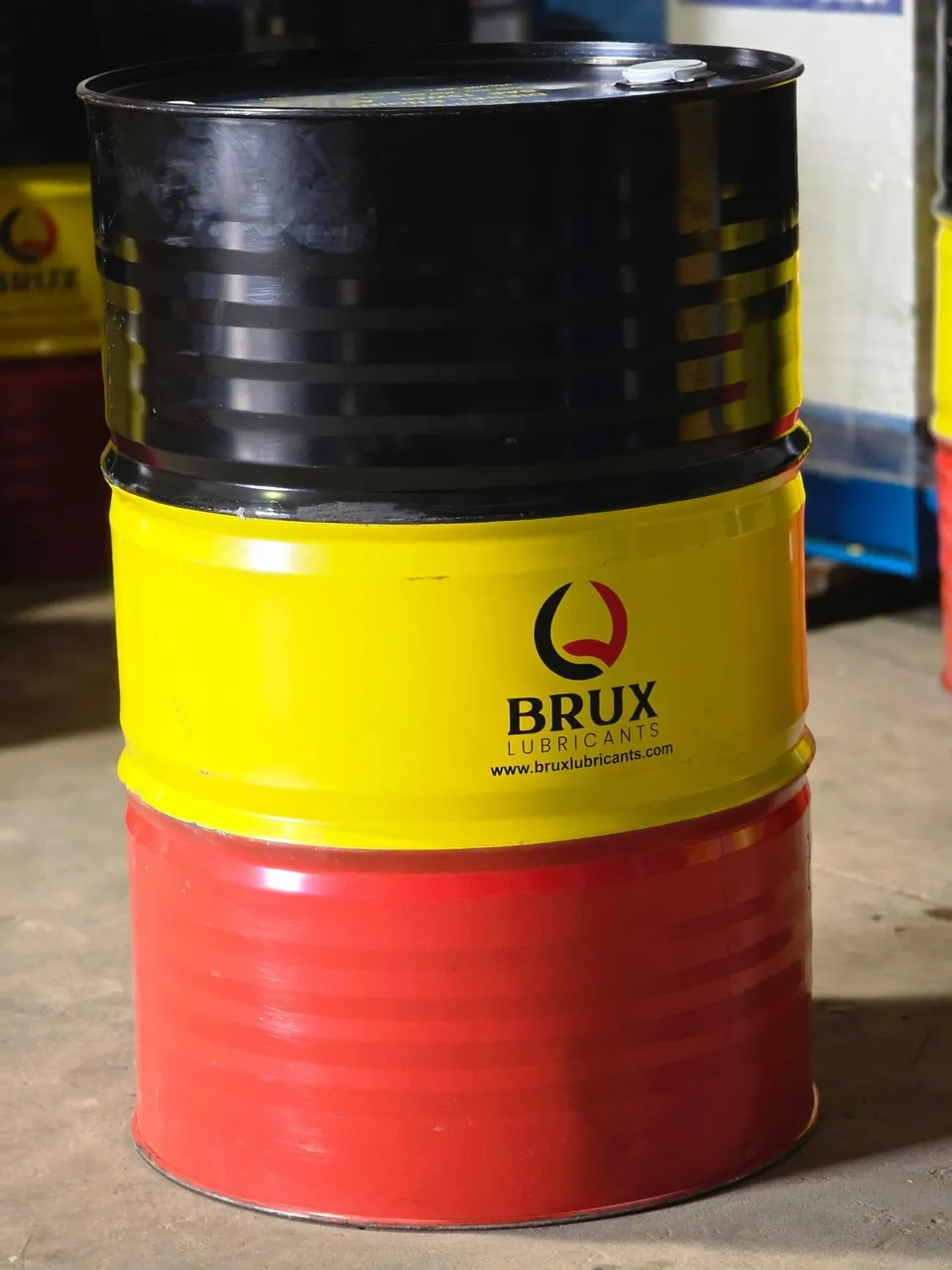
- Pack
- 208 L drum (ref. BRUX 15W40 CI4 208L)
Price on request
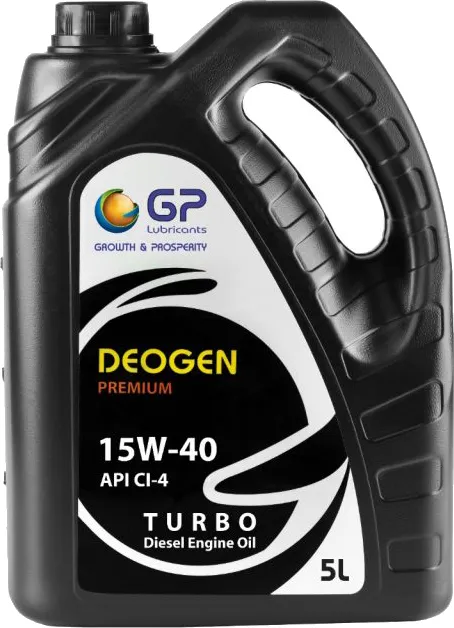
Lubricants · GP Lubricants
GP DeoGen Premium 15W-40 API CI-4 diesel engine oil
- Viscosity grade
- SAE 15W-40
- API category
- API CI-4 (5 L) · API CI-4/SL (20 L)
- Oil type
- Mineral (GP data sheet)
- Packs
- 5 L can (ref. GP DP 15W40 CI4 5L) · 20 L can, label API CI-4/SL (ref. GP DG 15W40 CI4 20L)
Price on request
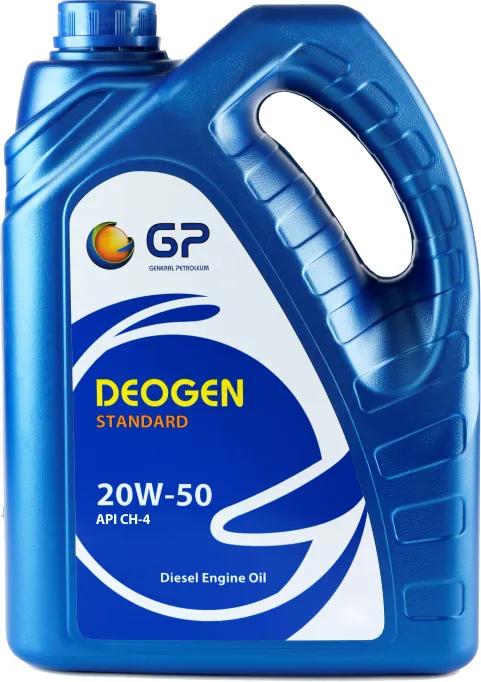
Lubricants · GP Lubricants
GP DeoGen Standard 20W-50 API CH-4 diesel engine oil
- Viscosity grade
- SAE 20W-50
- Oil type
- Mineral (GP data sheet)
- Pack
- 5 L can (ref. GP DG 20W50 CH4 5L)
Price on request


Related categories