

Contents
In October 2026, Kinshasa receives about 390 to 450 MW against the 1,200 MW it needs (SNEL's Director General, quoted by LePoint.cd on 2 October 2026). To keep power during cuts, do three things: list the appliances that must keep running, choose a generator based on its prime rating, then check how many hours its tank lasts.
Situation as of 20 October 2026. Power received by Kinshasa: 390 to 450 MW. Demand: 1,200 MW. Source: SNEL's Director General, quoted by LePoint.cd (2 October 2026). This box will be updated when SNEL publishes new figures.
Why do power cuts last so long in Kinshasa?
Power cuts last because the city receives only about a third of the electricity it needs. With 390 to 450 MW against 1,200 MW required, the shortfall is 750 to 810 MW. SNEL therefore rotates the available power between districts. This is load shedding, known locally as délestage.
As long as that gap remains, any home, shop or office that depends on electricity needs its own power source, for cuts that can last a whole evening or a whole night.
Which appliances should you keep running during a cut?
Start with a list of the appliances that must never stop. The shorter the list, the smaller the generator can be and the longer its tank lasts.
In a home, a typical list includes:
- lighting;
- the fridge and the freezer;
- the water pump or booster pump;
- the internet router, phones and a computer;
- one split air conditioner, ideally an inverter model.
Appliances with a motor (pump, air conditioner, fridge) draw far more power when they start than when they run. That starting surge, rather than the total of all appliances, often sets the generator size. Our guide What Size Generator for a House in Kinshasa? gives two worked examples. For your own list, use our finder to estimate the power you need. For a shop, clinic or workshop, our guide Generator Sizing for a Shop, Clinic or Workshop: 3 Worked Examples walks through worked examples.
What power rating do you need for long cuts?
For cuts of several hours every day, choose the generator based on its prime rating (PRP), not its standby rating (ESP). Prime power is designed for unlimited hours at variable load. Standby power is reserved for occasional outages and limited running hours.
During daily load shedding, your generator becomes your main source. So read the "Prime Power" value on the datasheet, not the "Standby Power" value, which is often printed first:
| Generator (Perkins engine) | Prime power (PRP) | Standby power (ESP) |
|---|---|---|
| 403A-15G1 | 13 kVA (10.4 kW) | 15 kVA (11.4 kW) |
| 404A-22G1 | 20 kVA (16 kW) | 22.3 kVA (17.8 kW) |
| 1103A-33TG2 | 60 kVA (48 kW) | 66 kVA (52.8 kW) |
| 1104C-44TAG2 | 100 kVA (80 kW) | 110 kVA (88 kW) |
Values from the datasheets of our 13 kVA, 20 kVA, 60 kVA and 100 kVA generators with Perkins engines. The difference between the two ratings is explained in our guide Prime (PRP) vs Standby (ESP) Power: Which Rating Matters?.
These generators are three-phase (400/230 V). In a house wired single-phase, the electrician spreads the circuits across the three phases; see our guide Single-Phase or Three-Phase Generator.
How many hours does a generator tank last?
At full load, the tanks of the four soundproof generators in the table below (13, 20, 60 and 100 kVA) last 8.6 to 12.2 hours, according to our datasheets. The table shows the worst case: fuel use at 100% load as stated on the datasheet.
| Generator (Perkins engine) | Fuel use at 100% | Soundproof tank | Soundproof runtime | Open-frame tank | Open-frame runtime |
|---|---|---|---|---|---|
| 13 kVA (403A-15G1) | 3.7 L/h | 45 L | 12.2 h | 50 L | 13.5 h |
| 20 kVA (404A-22G1) | 5.3 L/h | 55 L | 10.4 h | 65 L | 12.3 h |
| 60 kVA (1103A-33TG2) | 14 L/h | 120 L | 8.6 h | 110 L | 7.9 h |
| 100 kVA (1104C-44TAG2) | 22.6 L/h | 205 L | 9.1 h | 150 L | 6.6 h |
Calculation: tank capacity ÷ full-load fuel use stated on the datasheet.
At partial load, the generator burns less fuel and runs longer. Our guide Diesel Generator Fuel Consumption gives the estimation method and the full table from 13 to 2,000 kVA. If a cut lasts longer than the tank's runtime, plan a refill or an external tank.
For a small load, the Bison BS6250iE inverter generator is rated at 5.0 kW at 220 V single-phase. It runs on petrol, with an 11 L tank. Its datasheet states a runtime of 8 hours (load not specified) and 67 dB at 7 m. For a small home on diesel, the Brux BX6500DSE is rated at 5.75 kVA at 220 V single-phase. It has remote start and an ATS port for connecting an automatic transfer switch.
Where should you install a generator that runs all night?
Install the generator outdoors, sheltered from rain, or in a ventilated room used only for that purpose. Never inside a house, garage or basement: exhaust fumes kill, even with the door open.
For a generator that runs at night:
- point the exhaust away from bedrooms and neighbours;
- prefer a soundproof version: our 13 to 100 kVA generators with Perkins engines show 75 dBA at 3 m on their datasheets;
- have a qualified electrician connect the generator, with earthing and a changeover switch;
- store fuel in a closed container, away from the generator and any flame.
The full rules are in our guide Installing a Generator Safely.
Should you buy or rent during a period of power cuts?
For daily cuts that last for months, buying is usually the better fit. Renting suits a temporary need: an event, a building site, or cover while your own generator is being repaired.
Our guide Renting or Buying a Generator lists what to prepare. For a temporary need, see our generator rental page. To buy, browse our full generator range.
Frequently asked questions
How many hours does a generator run on one tank?
It depends on the tank and the load. At full load, a soundproof 20 kVA generator runs about 10.4 hours on its 55 L tank. At partial load, it runs longer.
Can a generator run all night?
Yes, if its prime rating covers your load and it is installed outdoors, with the exhaust pointing away from bedrooms. Check that the tank runtime covers the length of the cut.
Is a bigger generator safer for power cuts?
Not necessarily. An oversized generator runs at low load. A diesel engine that runs for long periods below about 30% of its prime rating burns its fuel poorly and builds up soot and unburnt fuel (the exact threshold is in the engine manual). A generator sized for your essential appliances is the better choice. Our guide Oversized Generator, Light Load gives worked examples.
Can I plug a generator into a wall socket?
No. Power can flow back into the SNEL grid and electrocute technicians working on the line. The connection must go through a changeover switch.
Ask for a quote
Send us your list of appliances and the usual length of your power cuts on WhatsApp at +243 903 005 060. Our team will suggest a suitable generator. Prices on request.
Sources: SNEL Director General, quoted by LePoint.cd (2 October 2026); datasheets of our Perkins-engine generators and of the Bison and Brux models; calculation method of the MK Energies & Services generator finder.
A question?
Our team answers on WhatsApp or through the contact form.
Products mentioned
- Fuel at 100%
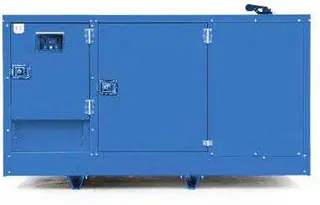
- 3.7 L/h
- Tank, soundproof
- 45 L
- Sound level
- 75 dBA
- Weight, soundproof
- 850 kg
- Soundproof or open skid
Price on request
- Fuel at 100%
- 5.3 L/h
- Tank, soundproof
- 55 L
- Sound level
- 75 dBA
- Weight, soundproof
- 950 kg
- Soundproof or open skid
Price on request
- Fuel at 100%
- 14 L/h
- Tank, soundproof
- 120 L
- Sound level
- 75 dBA
- Weight, soundproof
- 1,550 kg
- Soundproof or open skid
Price on request
- Fuel at 100%
- 22.6 L/h
- Tank, soundproof
- 205 L
- Sound level
- 75 dBA
- Weight, soundproof
- 1,920 kg
- Soundproof or open skid
Price on request
Related categories