

Contents
A generator is maintained according to its running hours. Before each start, check the oil, coolant, fuel, leaks and battery. A standby set should run under load once a month. Oil and filter changes follow the intervals in the engine manual. Plan at least one full service a year, even if the generator has run little.
Why does maintenance matter so much in Kinshasa?
A generator in Kinshasa works harder than in many other cities. During load-shedding it can run for several hours a day. Heat puts strain on the cooling system. Dust in the dry season clogs the air filter. Badly stored fuel carries water and dirt into the fuel system.
These conditions make regular checks essential. A well-kept generator starts when the power goes. A neglected one tends to fail at the worst moment.
What should you check before every start?
Six visual checks before each start are enough. Do them with the generator stopped and standing level.
- Check the engine oil level on the dipstick.
- On a water-cooled set, check the coolant level in the expansion tank with the engine cold.
- Check the fuel level.
- Look for oil, fuel or coolant under the set and around the engine.
- Check the battery: clean, tight terminals and cables in good condition.
- Clear the air inlets, the air outlets and the exhaust outlet.
Never open the radiator cap on a hot engine. The coolant is under pressure and can cause serious burns.
What should you do every week and every month?
A standby generator should run under load at least once a month. This test confirms that it starts, takes the load and raises no alarm.
Every week, or more often if the set runs daily:
- check the battery's state of charge;
- clean the terminals if they corrode;
- drain the fuel filter's water separator, if your set has one;
- write down the hours shown on the hour meter.
Every month, run the test under load. Connect a real load: a diesel set that runs for long periods with little or no load burns its fuel poorly and builds up deposits. Let it run long enough to reach its normal operating temperature.
The US standard NFPA 110 gives a useful benchmark. For standby generators in critical buildings, it requires a monthly exercise of at least 30 minutes.
A weak battery is a common cause of hard starting. If the set struggles to start during the test, have the battery and charger checked.
When should the oil and filters be changed?
Oil, filters, coolant and belts are replaced at the intervals in the engine's operation and maintenance manual. These intervals depend on the engine and the manufacturer. Manuals usually give one interval in running hours and one in months: whichever comes first applies.
| Item | Task | Reference |
|---|---|---|
| Engine oil and oil filter | Oil change and new filter | Engine manual |
| Fuel filters | Replacement, water separator drain | Engine manual |
| Air filter | Inspection and replacement, more often in dusty conditions | Engine manual, restriction indicator if fitted |
| Coolant | Level, condition and replacement (water-cooled sets) | Engine manual |
| Belts | Tension and wear | Engine manual |
| Battery | Charge, terminals, electrolyte level if the battery is not sealed | Weekly (charge, terminals), monthly (electrolyte) |
For example, for a 100 kVA generator with a Perkins 1104C-44TAG2 engine, these intervals are in the Perkins manual for that engine. On our Perkins-engine sets, the Deep Sea control module shows the running hours. Record them in a service log at every visit.
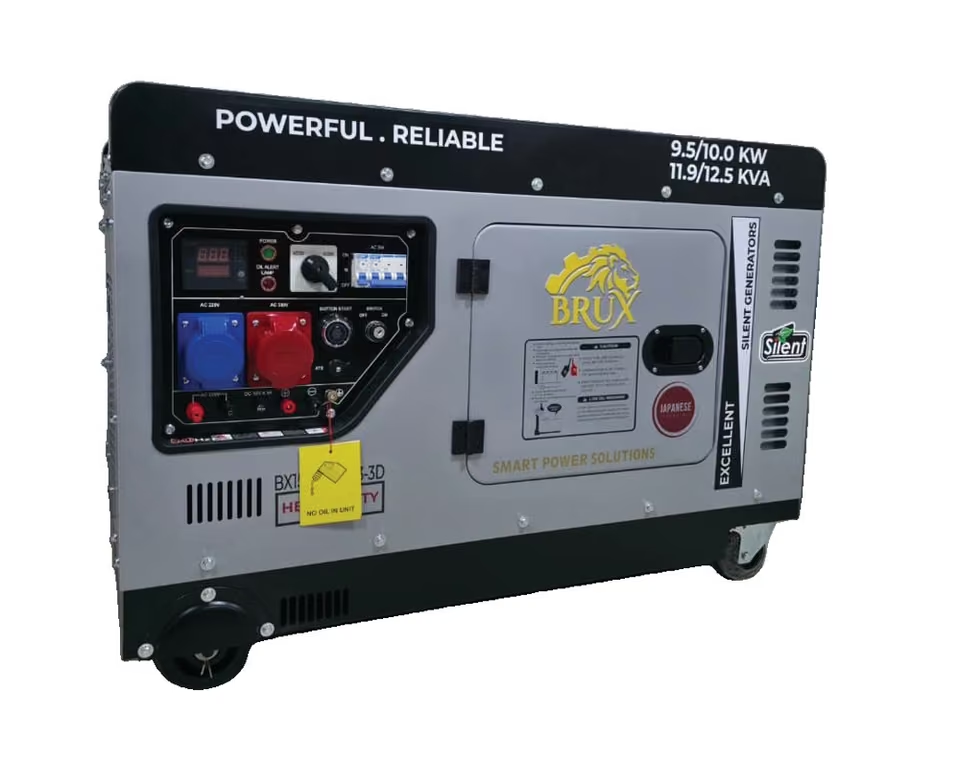
The small air-cooled Bison and Brux sets follow their own manufacturer's manual. They have no coolant, but oil and the air filter still matter.
Overdue maintenance often shows up in fuel use. If your generator burns more than before for the same load, compare it with our generator fuel consumption table.
What does the yearly service cover?
Have a technician service your generator at least once a year, even if it has run little. Oil and coolant age over time. Hoses and seals harden. Stored fuel deteriorates.
A full service usually covers:
- the oil and filter changes set out in the manual;
- the cooling system, radiator and hoses;
- the belts and the fan;
- the battery and the charger;
- the electrical connections and the alternator;
- the control module and the safety shutdowns (oil pressure, temperature);
- a final test under load.
Which mistakes damage a generator?
Six common mistakes shorten a generator's life.
- Running a diesel set for long periods at very low load.
- Using dirty fuel or fuel stored in open drums.
- Ignoring a warning lamp or a control-module alarm.
- Forgetting to top up the coolant in hot weather.
- Leaving a standby set for months without starting it.
- Using an oil that does not meet the specification in the manual.
Our guide to the oversized generator explains why low load clogs a diesel engine. A badly installed generator also wears faster. Location, ventilation and exhaust are covered in our guide to installing a generator safely.
When should you call MK Energies & Services?
Call a technician as soon as you see any of these signs:
- black smoke from the exhaust;
- hard starting or misfiring;
- unusual noise or vibration;
- unstable voltage or frequency;
- repeated alarms;
- an oil, fuel or coolant leak.
Before the visit, our guide Generator won't start, stalls or smokes black: what to check helps you describe the fault.
MK Energies & Services provides preventive and corrective generator maintenance: periodic servicing, diagnosis and repair. We also supply spare parts and service consumables for the equipment we sell. Tell us the brand, the model and, if possible, the serial number.
Looking for a new generator? Browse our generators, or see all our services.
Sources: engine manufacturers' operation and maintenance manuals (Perkins), NFPA 110 standard.
A question?
Our team answers on WhatsApp or through the contact form.
Related categories