

Contents
kVA measures the apparent power a generator can deliver; kW measures the power your appliances can actually use. Generators are rated at a power factor of 0.8: kW = kVA × 0.8. A 100 kVA generator therefore delivers 80 kW, as the datasheets of our Perkins-engine sets show (100 kVA = 80 kW).
What do kVA, kW and power factor measure?
kVA and kW are two ways of measuring electrical power, linked by the power factor. For a generator, the datasheet power factor is 0.8.
- kVA (kilovolt-ampere) is apparent power: the voltage multiplied by the current the alternator has to supply.
- kW (kilowatt) is real power: the power that turns a motor, lights a room or heats water.
- The power factor (cos φ) is the ratio between the two: kW ÷ kVA, between 0 and 1.
Resistive loads, such as a water heater or an iron, have a power factor close to 1. Motors, fridge and air-conditioner compressors and some electronic equipment have a lower one. For these loads the generator must supply more kVA for the same number of kW.
Manufacturers rate generators at a power factor of 0.8. This reference value reflects an installation that mixes resistive loads and motors.
kVA to kW conversion table for our generators
The datasheets of our Perkins-engine sets give prime power in both kVA and kW, always in a ratio of 0.8. The table lists ten models from 13 to 2,000 kVA.
| Power (kVA) | Power (kW) | Perkins engine |
|---|---|---|
| 13 | 10.4 | 403A-15G1 |
| 20 | 16 | 404A-22G1 |
| 30 | 24 | 1103A-33G |
| 45 | 36 | 1103A-33TG1 |
| 60 | 48 | 1103A-33TG2 |
| 100 | 80 | 1104C-44TAG2 |
| 200 | 160 | 1106A-70TAG4 |
| 500 | 400 | 2506A-E15TAG2 |
| 1,000 | 800 | 4008-30TAG2 |
| 2,000 | 1,600 | 4016-61TRG2 |
These are prime power (PRP) values. Standby power is about 10 to 15% higher on these datasheets. Our guide to prime vs standby power explains which one to use. See every model in our diesel generator range.
Are small generators rated in kW or kVA?
Our small Bison petrol generators are rated in kW: 2.0 to 7.0 kW for the open-frame models and 2.3 to 5.0 kW for the inverters. Our small Bison and Brux diesels are rated in kVA. The Brux datasheets also give kW: 5.75 kVA, or 4.6 kW, for the Brux BX6500DSE.
Our finder counts the kW of petrol sets as kVA, with no uplift. This is the most cautious assumption: a 5 kW set is only recommended for a need of up to 5 kVA. You can check this when you use the finder to work out your generator size. See also our petrol generators.
How do you work out the current in amps?
The current a generator supplies depends on its apparent power (kVA) and the voltage. The formulas:
- three-phase: I = S ÷ (√3 × U);
- single-phase: I = S ÷ U.
S is the apparent power in VA, U the voltage in volts and I the current in amps.
| Generator | Voltage | Current |
|---|---|---|
| 20 kVA, three-phase | 400 V | about 29 A per phase |
| 100 kVA, three-phase | 400 V | about 144 A per phase |
| 5 kVA, single-phase | 230 V | about 21.7 A |
Worked example for the 20 kVA set: 20,000 VA ÷ (1.732 × 400 V) ≈ 29 A.
These figures help you prepare an installation. Cable sizes and breaker ratings are chosen by a qualified electrician. Our installation and commissioning service can take care of it.
kWm and kWe: what is the difference on a datasheet?
kWm is the engine's mechanical power; kWe is the electrical power the generator delivers. The datasheet of our 13 kVA set lists a 12 kWm engine for an electrical output of 10.4 kWe. The engine is more powerful than the electrical output because it also drives the radiator fan and the alternator has losses.
When you compare generators, always compare electrical power (kVA or kWe), never engine power.
From your appliances to the generator size
Your appliances are rated in watts, the generator in kVA. To convert, divide the power in kW by 0.8, then add a reserve and the start-up surge of any motors. Our finder does this calculation for you: use it to work out your generator size.
For a full example, see our guide What size generator for a house in Kinshasa?.
Frequently asked questions
Can a 10 kVA generator run 10 kW of appliances?
No. At a power factor of 0.8, a 10 kVA generator delivers 8 kW. For 10 kW of appliances you need at least 12.5 kVA, before any reserve.
Why does my air conditioner need more kVA than kW?
Because it is a motor. Its power factor is below 1, and it draws a heavy current surge when it starts. The generator must supply those extra kVA.
Sources: manufacturers' datasheets (Perkins engines, Leroy-Somer alternators, Bison and Brux generators), MK Energies & Services finder calculation method.
A question?
Our team answers on WhatsApp or through the contact form.
Products mentioned
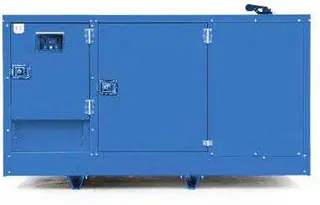
- Fuel at 100%
- 22.6 L/h
- Tank, soundproof
- 205 L
- Sound level
- 75 dBA
- Weight, soundproof
- 1,920 kg
- Soundproof or open skid
Price on request
Related categories