

Contents
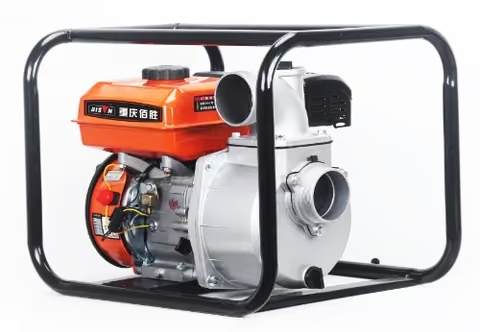
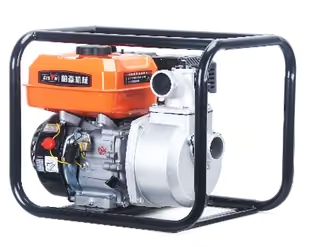
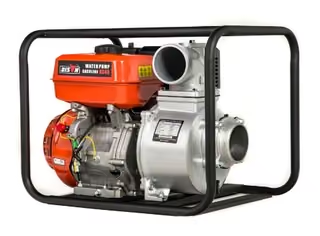
A petrol water pump's inch size is its outlet diameter; it shows the flow class. The Bison BS30 (3 in) moves up to 50 m³/h and the Bison BS40 (4 in) up to 60 m³/h. Both reach a total head of 30 m, including up to 7 m of suction lift. The 2-inch Bison BS20 suits smaller jobs.
What do 2, 3 and 4 inches mean on a water pump?
The inch figure is the diameter of the outlet, where the delivery hose connects. One inch is 25.4 mm. Our datasheets give the matching nominal diameter: 50 mm for 2 in, 80 mm for 3 in and 100 mm for 4 in.
A wider outlet lets more water through per second. So the inch size tells you the pump's flow class, not how high it can push water. Our three models all reach a similar head: 28 m for the BS20, 30 m for the BS30 and the BS40.
Use a hose of the same diameter as the outlet. A narrower hose holds the water back and costs a large share of the rated flow.
Why can a petrol water pump not lift water more than 7 m?
A surface pump does not really pull water up. It creates a vacuum in the hose, and air pressure pushes the water towards the pump. At sea level, that pressure can hold up a column of about 10 m of water at best. This is a physical limit that applies to every surface pump.
In practice, friction, leaks at the fittings and water temperature reduce that theoretical figure: the BS30 and BS40 datasheets give 7 m as the maximum. The BS20 datasheet does not state this value. Some electric surface pumps in our range are rated 8 to 9 m.
What this means on site:
- Measure the vertical distance between the water surface and the pump, not the hose length. If the water is more than 7 m below the pump, move the pump closer to the water.
- Keep the suction hose short and airtight. A single air leak can make the pump lose its prime. Use a reinforced hose that does not collapse under vacuum.
- Fit a strainer on the end of the hose. It stops leaves, stones and weeds before they reach the impeller.
- Fill the pump casing with water before starting. A pump must not run dry. Follow the manual supplied with the unit.
If the water is more than 7 m below the pump, a petrol water pump at the surface will not work. Our LEO submersible pumps sit in the water, down to 10 m for the STK50F, but they are not designed for deep boreholes. Describe your well and we will tell you what is possible.
What are the specifications of the three Bison petrol water pumps?
The table uses the values from our datasheets. All three models have a single-cylinder, four-stroke, air-cooled petrol engine, a recoil start and a 3.6 L fuel tank. “n/a” means the value is not given on the datasheet. The BS20 datasheet gives a flow of 36 without a unit.
| Model | Outlet | Max flow | Max total head | Max suction | Engine | Weight | Dimensions |
|---|---|---|---|---|---|---|---|
| BS20 | 2 in (50 mm) | 36 (unit not stated) | 28 m | n/a | 170F, 7.0 HP | 21 kg | 49 × 39 × 41 cm |
| BS30 | 3 in (80 mm) | 50 m³/h | 30 m | 7 m | 168F-1, 196 cc | 22 kg | 51 × 39 × 43 cm |
| BS40 | 4 in (100 mm) | 60 m³/h | 30 m | 7 m | 170F, 210 cc | 24 kg (gross, datasheet) | 56 × 44 × 49.5 cm |
Maximum flow and maximum head are not reached at the same time: the higher and further you send the water, the lower the flow. At 30 m of head, it drops to almost zero. The 30 m is the total head: suction lift, delivery height and hose losses combined. If the pump already lifts 7 m on the suction side, at best about 23 m remain on the delivery side. The full PDF datasheets are on each product page and on our petrol water pumps page.
Irrigation, draining or transfer: which model?
To irrigate a field or a large garden, start from the volume of water to apply. One millimetre of water over one hectare is 10 m³. Example: applying 20 mm over 1 ha takes 200 m³. At maximum flow, the BS30 takes about 4 hours and the BS40 just over 3 hours. On site, allow more time, because the real flow drops with height and hose length. For several hectares, the BS40 saves time. For a vegetable plot, the BS30 is often enough.
To drain a pit, a trench or a flooded basement, the BS30 and the BS40 move large volumes quickly. Keep the pump at the edge, never at the bottom of a pit: exhaust gases contain carbon monoxide, an invisible, odourless gas that builds up in confined, poorly ventilated spaces. Muddy water full of sand wears the impeller. Our datasheets do not give the maximum solids size these three models accept. For water carrying a lot of solids, a drainage pump built for solids is a better fit: see our guide to flood drainage and dirty-water pumps.
To transfer water from a pond or a river, the BS20 (21 kg) is enough to fill a tank or water a kitchen garden. The BS30 and the BS40 are for moving tens of cubic metres.
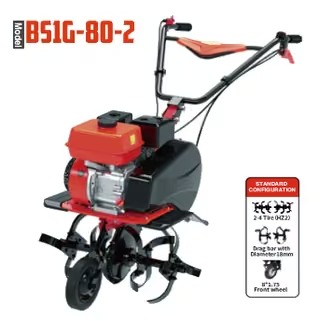
Equipping a farm? We also offer Bison power tillers in our agricultural equipment range.
Petrol water pump or electric pump on a generator?
Choose a petrol water pump if you work far from any grid and often move between water sources. It carries its own engine: no cable, no generator, one machine to transport.
Choose an electric pump if the pump stays in one place and you have power, even intermittently. An electric pump can be controlled by a pressure switch or a float and then run unattended. When the grid is down, a generator can supply it. The pump motor draws a lot of current at start-up: size the generator with our Generator Finder.
For a house, a cistern or a water tower, our guide which water pump for a house compares the main types of electric pump.
Where can you see these pumps in Kinshasa?
All three pumps belong to our Bison range, and we are an authorised Bison dealer. You can see them at our showroom in Gombe, No. 26, Avenue des Huileries, opposite the INRB. We also deliver to other provinces of the DRC. We handle maintenance, after-sales service and spare parts: see our services.
Ask for a quote on WhatsApp: open the page of the pump you want and tap the WhatsApp button, or message +243 903 005 060. Tell us what the pump is for, the height between the water and the pump, and how far the water must travel. Prices on request.
Frequently asked questions
What flow does a 3-inch petrol water pump deliver?
Our 3-inch Bison BS30 (80 mm outlet) moves up to 50 m³/h, about 833 L/min. That maximum drops as the head and hose length increase.
How long does it take to fill a 10 m³ tank?
At maximum flow, about 12 minutes with the BS30 (50 m³/h) and 10 minutes with the BS40 (60 m³/h). Allow longer in practice: flow drops with height and hose length.
Can a petrol water pump handle muddy water?
Slightly cloudy water is fine with a strainer. Sand and debris wear the impeller. Our datasheets do not state the accepted solids size: for water carrying a lot of solids, choose a pump built for solids.
Sources: manufacturer datasheets (Bison petrol water pumps, LEO pumps), standard physics of suction lift (atmospheric pressure) and irrigation volume conversion (1 mm over 1 ha = 10 m³).
A question?
Our team answers on WhatsApp or through the contact form.
Products mentioned
- Max flow
- 36
- Max head
- 28 m
- Outlet
- 50 mm
- Engine
- 170F
Price on request
Petrol pumps
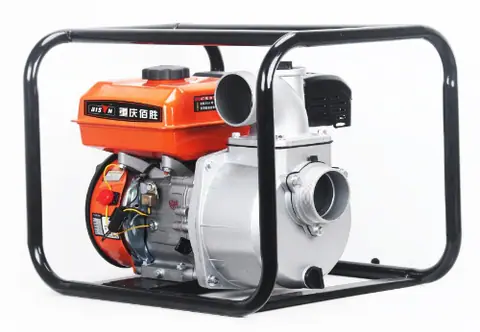
Bison petrol water pump BS30
- Max flow
- 50 m³/h
- Max head
- 30 m
- Outlet
- 80 mm
- Engine
- 168F-1
Price on request
Petrol pumps
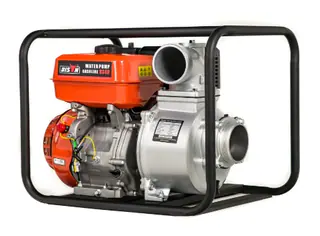
Bison petrol water pump BS40
- Max flow
- 60 m³/h
- Max head
- 30 m
- Outlet
- 100 mm
- Engine
- 170F
Price on request
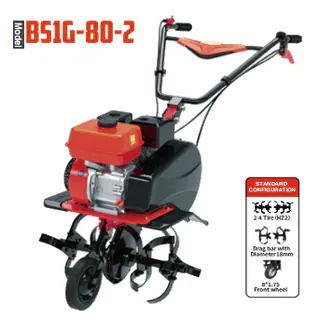
- Tillage width
- 700-880 mm
- Tillage depth
- ≥100 mm
- Gears
- 0/1
- Engine type
- BS170F
Price on request
Related categories