

Contents
For a house, the choice depends on the water source and the need. An automatic booster pump raises the pressure from the mains or a tank. A peripheral pump gives high pressure at low flow, a centrifugal pump more flow. A jet pump draws water from up to 9 m. A submersible pump empties a tank or removes waste water.
Where does your water come from?
The water source determines the type of pump. Start there, then check the head and the flow.
- Low-pressure mains supply: a booster pump raises the pressure at the tap.
- Ground-level tank or cistern: a booster pump supplies the house, or a peripheral or centrifugal pump fills the roof tank.
- Shallow well: a surface pump works if the suction lift, including suction-pipe losses, stays below its data sheet value (8 m at most for the APM, ACM and 2ACM, 6 m for the XKM80-1, 9 m for the AJM110H jet pump).
- Deeper water: you need a pump placed in the water.
- Tank to empty, rainwater or waste water: a submersible drainage pump.
- Swimming pool: a pool pump, which circulates the water through the filter.
Each case has its own detailed guide: low water pressure at home, a submersible pump to drain floods, pits and basements, pool pump flow rate and petrol water pumps for irrigation, draining or transfer.
Head, flow and suction lift: how do you read a pump data sheet?
Three figures matter on a data sheet: maximum head, maximum flow and maximum suction lift. A pump never reaches all of them at once.
Total dynamic head (TDH) is the height the water must be lifted plus the friction losses in pipes, bends and valves. To fill a tank 10 m above the pump, the TDH is therefore more than 10 m. A head of 10 m of water is roughly 1 bar of pressure.
Maximum head and maximum flow are two extremes. The pump reaches its maximum head at almost zero flow. It reaches its maximum flow at almost zero head. In between, the curve on the data sheet gives the real flow at your head.
Suction lift applies to surface pumps, which draw water up by suction. The LEO data sheets give 8 m maximum suction for the APM, ACM and 2ACM pumps and 9 m for the AJM110H. The physical limit at sea level is about 10 m of water. Beyond that, the pump must sit in the water.
Two points to check:
- power supply: most models in our range are single-phase, like the supply in most homes;
- dry running: a surface pump must not run dry (follow the instructions on its data sheet).
Which pump families suit a house?
MK Energies & Services is an authorized LEO dealer in Kinshasa. Our range of water pumps covers household needs, family by family.
Booster pumps
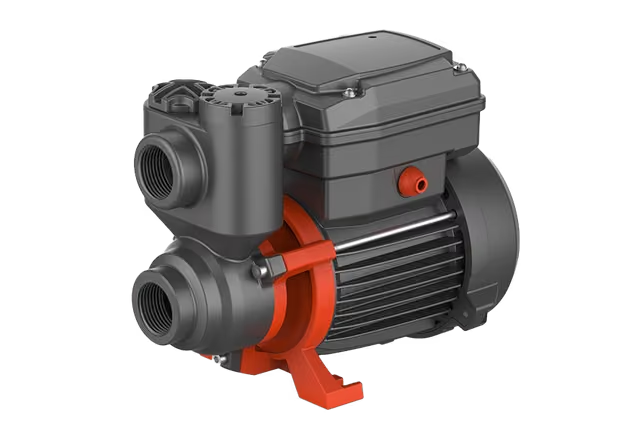
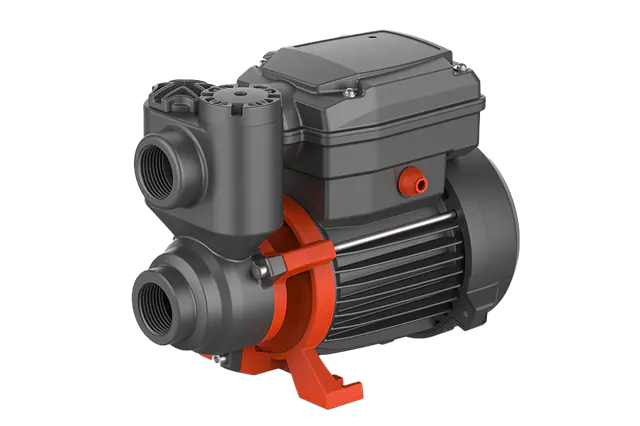
A booster pump raises the pressure of water from the mains or a tank. The LEO PQ50E-1 booster pump has a 0.37 kW motor. It reaches a head of up to 30 m and a flow of up to 33 L/min.
Peripheral pumps
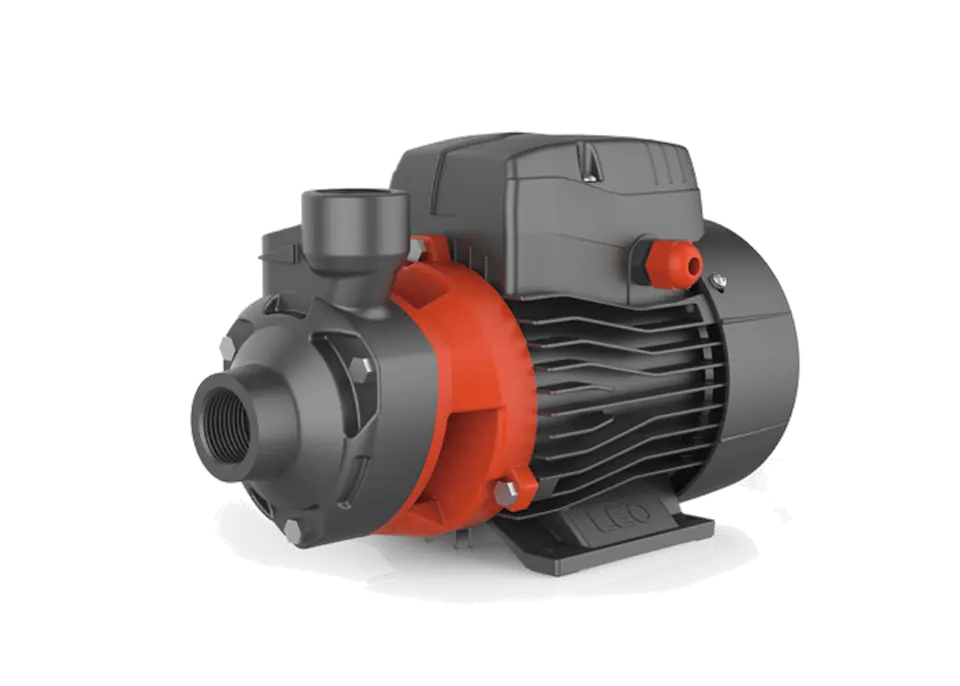
Peripheral pumps deliver high pressure at low flow. The LEO APM110 reaches a maximum head of 85 m and a maximum flow of 4.2 m³/h.
Centrifugal pumps
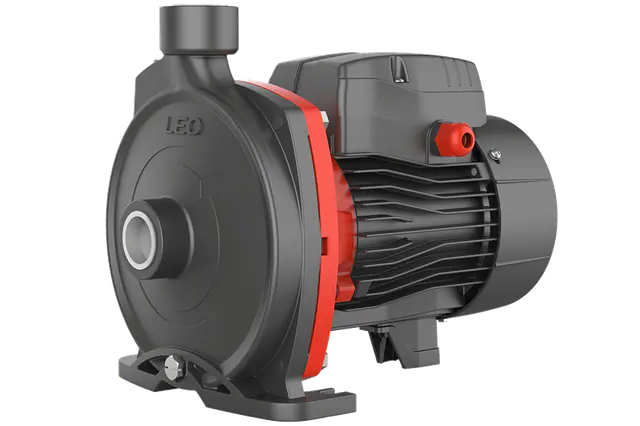
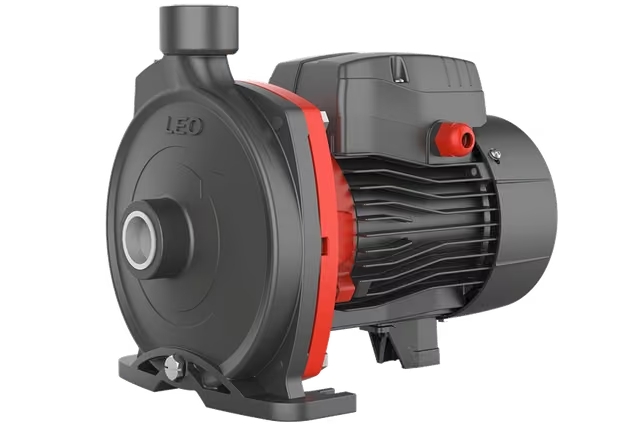
Centrifugal pumps deliver more flow and less head. The LEO ACM75 delivers up to 6.0 m³/h and reaches up to 36 m.
Multistage pumps
A multistage pump has several impellers in series. It combines good flow with a higher head. The LEO 2ACM150 reaches a maximum head of 55 m and a maximum flow of 7.8 m³/h.
Jet pumps
A jet pump is self-priming. It draws water from deeper than a standard surface pump. The LEO AJM110H has a suction lift of up to 9 m.
Submersible pumps
The submersible pumps in our catalogue sit in the water. The sewage and drainage models (LSWM100A, LSWM150A, AKS-751PWH, QDX1.5-32-0.75LA) empty tanks or remove rainwater or waste water. The AKS-751PWH handles particles up to 35 mm. The LKS-300P draws from a rainwater tank. The STK50F, a submersible peripheral pump, reaches a head of up to 35 m and can be immersed down to 10 m. The LEO LSWM100A delivers up to 19 m³/h.
Pool pumps
The LEO XKP1104E and XKP1604E pool pumps circulate the water through the filter.
Petrol water pumps
The Bison petrol water pumps move large volumes of water where there is no electricity.
Table of LEO pumps
This table gives the values from the LEO data sheets in our catalogue. “Not stated” means the data sheet does not give the value.
| Model | Type | Power | Max head | Max flow | Max suction or immersion |
|---|---|---|---|---|---|
| APM110 | Peripheral | 1.1 kW | 85 m | 4.2 m³/h | suction 8 m |
| APM150 | Peripheral | 1.5 kW | 90 m | 4.8 m³/h | suction 8 m |
| XKM60-1 | Peripheral | 0.37 kW | 40 m | 2.4 m³/h | not stated |
| XKM80-1 | Peripheral | 0.75 kW | 70 m | 3.6 m³/h (60 L/min) | suction 6 m |
| PQ50E-1 | Booster | 0.37 kW | 30 m | 2.0 m³/h (33 L/min) | not stated |
| ACM37 | Centrifugal | 0.37 kW | 23 m | 5.4 m³/h | suction 8 m |
| ACM75 | Centrifugal | 0.75 kW | 36 m | 6.0 m³/h | suction 8 m |
| 2ACM150 | Multistage | 1.5 kW | 55 m | 7.8 m³/h | suction 8 m |
| AJM75H | Jet | 0.75 kW | 50 m | 2.8 m³/h | not stated |
| AJM110H | Jet | 1.1 kW | not stated | not stated | suction 9 m |
| XKP1104E | Pool | 1.1 kW | 15 m | 22.5 m³/h | suction 3.5 m |
| XKP1604E | Pool | 1.6 kW | 17 m | 27 m³/h | suction 3.5 m |
| AKS-751PWH | Submersible | 0.75 kW | 8 m | 14 m³/h | immersion 7 m |
| LKS-300P | Submersible | 0.3 kW | 11 m | 2.2 m³/h | immersion 7 m |
| STK50F | Submersible | 0.37 kW | 35 m | 2.4 m³/h | immersion 10 m |
| QDX1.5-32-0.75LA | Submersible | 0.75 kW | 32 m | 9 m³/h | not stated |
| LSWM100A | Submersible | 0.75 kW | 17 m | 19 m³/h | not stated |
| LSWM150A | Submersible | 1.1 kW | 13.5 m | 26 m³/h | not stated |
What size generator does a pump need?
A pump starts like an air conditioner: its motor draws far more current when starting than when running. Using our finder's method, a 1.1 kW pump started direct-on-line needs about 4.5 kVA on its own.
| Step | Calculation | Result |
|---|---|---|
| Convert to kVA (power factor 0.8) | 1.1 ÷ 0.8 | 1.38 kVA |
| 25% reserve | 1.38 × 1.25 | 1.72 kVA |
| Direct-on-line start (× 3) | 1.38 × 3 | 4.13 kVA |
| 10% margin on the start | 4.13 × 1.1 | 4.54 kVA |
| Required capacity (the larger of the two) | 1.72 or 4.54 | 4.54 kVA |
The start-up therefore sets the generator size. The smallest suitable set in our range is 5 kVA. If the pump shares the generator with other appliances, the need goes up. For your own case, use our finder to work out your generator size.
A whole house with a pump, a fridge and an air conditioner is covered in our guide to generator size for a house.
Frequently asked questions
Can a surface pump draw water from a deep borehole?
No. A surface pump draws water from about 8 m at most, 9 m for the AJM110H. The submersible pumps in our current catalogue are for drainage, sewage and emptying tanks, at depths of up to 10 m. They are not designed for deep boreholes.
Which pump fills a roof tank?
A surface pump, peripheral or centrifugal, that delivers the flow you want at your total head. A peripheral pump suits a high tank at low flow. A centrifugal pump fills a lower tank faster. Read the data sheet curve at your head.
Pump and generator: where do you start?
Choose the pump first, then size the generator from its power and how it starts. Our finder does the calculation for you: work out your generator size.
Sources: manufacturers' data sheets (LEO pumps), MK Energies finder calculation method.
A question?
Our team answers on WhatsApp or through the contact form.
Products mentioned
- Max flow
- 33 L/min
- Max head
- 30 m
- Inlet / outlet
- 1"
- Voltage
- 180-220 V / 50 Hz
Price on request
- Max flow
- 4.2 m³/h (70 L/min)
- Max head
- 85 m
- Max suction
- 8 m
- Single phase
- IPX4
Price on request
- Max flow
- 6.0 m³/h (100 L/min)
- Max head
- 36 m
- Max suction
- 8 m
Price on request
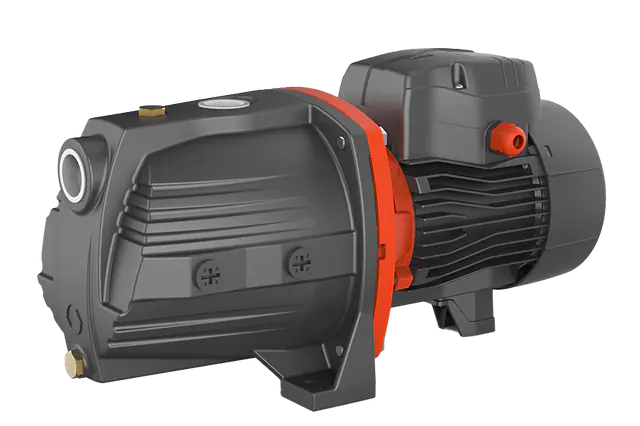
- Max suction
- 9 m
Price on request

Related categories