

Contents
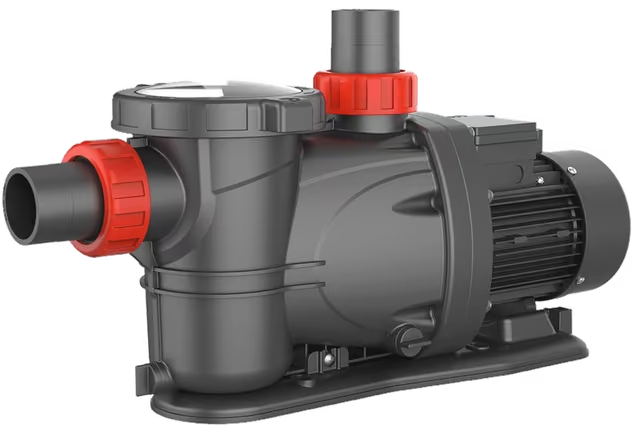
A pool pump should pass the whole volume of the pool through the filter in a few hours. Divide the pool volume in m³ by the number of hours you want: the result is the flow you need in m³/h. Example: 50 m³ turned over in 5 hours needs 10 m³/h. Then check the pump's actual flow at your circuit's head, which is always lower than its maximum flow. Our LEO XKP1104E and XKP1604E pool pumps deliver up to 22.5 m³/h and 27 m³/h respectively.
How do you work out your pool volume?
The volume equals the pool's surface area multiplied by its average depth. To get the average depth, add the shallow-end and deep-end depths, then divide by two. One cubic metre holds 1,000 litres.
| Shape | Formula | Example | Volume |
|---|---|---|---|
| Rectangular | length × width × average depth | 10 × 5 m, average depth 1.5 m | 75 m³ |
| Round | 0.785 × diameter² × average depth | 6 m diameter, 1.3 m | 36.7 m³ |
| Ellipse (true oval) | 0.785 × length × width × average depth | 9 × 5 m, 1.4 m | 49.5 m³ |
| Oval with rounded ends | (length − width) × width × average depth + 0.785 × width² × average depth | 9 × 5 m, 1.4 m | 55.5 m³ |
Most pools sold as oval are a rectangle with a half-circle at each end. For those, use the last row: the ellipse formula would give 6 m³ less here, and the pump would be undersized. For a freeform pool, split it into rectangles and half-circles, then add up the volumes. If you know how much water was delivered for the first fill, use that figure.
How many hours of filtration does a pool need each day?
Two durations matter, and they are easy to confuse.
- Turnover time is the time it takes for one full pool volume to pass through the filter. It sets the pump's flow rate.
- Daily run time is how long the pump runs over a day. It sets the timer.
Typically, a private pool pump is sized to turn the volume over in 4 to 6 hours. A hotel pool or a pool open to the public has more swimmers and usually aims for a faster turnover; the value is then set by the specification or the design engineer.
For daily run time, a widely used rule of thumb is: hours of filtration per day = water temperature (°C) ÷ 2. In water at 28 °C, that is 14 hours a day.
The flow you need is: volume (m³) ÷ turnover time (h) = flow (m³/h).
| Pool volume | Flow for a 6 h turnover | Flow for a 4 h turnover |
|---|---|---|
| 30 m³ | 5.0 m³/h | 7.5 m³/h |
| 50 m³ | 8.3 m³/h | 12.5 m³/h |
| 75 m³ | 12.5 m³/h | 18.8 m³/h |
| 100 m³ | 16.7 m³/h | 25.0 m³/h |
| 120 m³ | 20.0 m³/h | 30.0 m³/h |
Maximum flow or real flow: why is the data sheet not enough?
The maximum flow on a data sheet is measured at almost zero head. In a real circuit, the pump draws water through the skimmers, the suction pipe and the strainer, then pushes it through the filter, the valve, the pipes, the bends and the return jets. Each one adds friction loss, measured in metres of water. Together, these losses make up the total head: the higher it is, the lower the flow. At its maximum head, 15 m for the XKP1104E and 17 m for the XKP1604E, the pump delivers almost nothing.
The filter's pressure gauge is a useful guide: 1 bar is roughly 10 m of water. If your filter reads 1 bar, the XKP1104E is already working against at least 10 m, two thirds of its maximum head, plus the suction-side losses that the gauge does not measure. It then delivers well under 22.5 m³/h.
The LEO data sheets for our two pumps, downloadable from each product page, give the maximum flow and the maximum head, not the full curve. To estimate the flow at your head, send us the pool volume, the filter model and the pipe layout, and we will check the choice with you.
Three rules to remember:
- Keep a margin. Do not pick a pump whose maximum flow only just matches your need, because the real flow will be lower.
- Match the filter. The pump's flow must not exceed the filter's maximum rated flow, shown on its plate or in its manual. Water that passes through the filter too fast is filtered less well.
- Keep the pump close to the pool. The data sheet gives a maximum suction lift of 3.5 m. To be safe, keep the height between the water level and the pump, plus the suction-pipe losses, below that value. A pump that sits low and close to the pool performs better.
What are the specifications of the LEO XKP1104E and XKP1604E?
MK Energies & Services is an authorized LEO dealer in Kinshasa. According to their data sheets, our two pool pumps have a built-in strainer and circulate the pool water through the filter. These are the values from their data sheets.
| Specification | LEO XKP1104E | LEO XKP1604E |
|---|---|---|
| Power | 1.1 kW (1.5 HP) | 1.6 kW (2.2 HP) |
| Voltage / frequency | 220 to 240 V / 50 Hz | 220 to 240 V / 50 Hz |
| Maximum flow | 375 L/min (22.5 m³/h) | 450 L/min (27 m³/h) |
| Maximum head | 15 m | 17 m |
| Maximum suction lift | 3.5 m | 3.5 m |
| Inlet / outlet | 2″ (50 mm) | 2″ (50 mm) |
| Maximum water temperature | 35 °C | 35 °C |
How do you choose between them? Start from the flow you need. A 48 m³ pool (8 × 4 m, average depth 1.5 m) turned over in 5 hours needs 9.6 m³/h: the XKP1104E keeps a wide margin for circuit losses. A 100 m³ pool turned over in 4 hours needs 25 m³/h: that is more than the XKP1104E's maximum and close to the XKP1604E's. In that case, aim for a longer turnover, for example 6 hours, which is 16.7 m³/h. The XKP1604E then keeps the more comfortable margin for circuit losses, provided the filter is rated for that flow.
Can a pool pump run on a generator?
Yes, provided the generator can handle the motor's start-up. When it starts, a motor draws far more current than when it runs. Our finder makes two checks and keeps the larger of the two values: running with reserve, or the start-up surge with its margin. Here is the calculation for the pump on its own, with a direct-on-line start.
| Calculation | XKP1104E (1.1 kW) | XKP1604E (1.6 kW) |
|---|---|---|
| 1. Running apparent power (kW ÷ 0.8) | 1.38 kVA | 2.00 kVA |
| 2. Running + 25% reserve (row 1 × 1.25) | 1.72 kVA | 2.50 kVA |
| 3. Direct-on-line start surge (row 1 × 3) | 4.13 kVA | 6.00 kVA |
| 4. Start + 10% margin (row 3 × 1.1) | 4.54 kVA | 6.60 kVA |
| Required capacity: the larger of rows 2 and 4 | 4.54 kVA | 6.60 kVA |
Values are rounded to two decimal places; the finder shows one. The start-up sets the generator size. Both pumps are single-phase, 220 to 240 V and 50 Hz: the generator must supply 230 V single-phase at 50 Hz. On a three-phase 400/230 V generator, the pump connects between one phase and neutral. A single phase then supplies only about a third of the generator's capacity. Have an electrician balance the loads across the three phases. If the pump shares the generator with lighting, a salt chlorinator or the house, the need goes up. For your whole installation, use our finder to work out your generator size.
Looking for a pump for another job, such as a booster pump or filling a roof tank? Read our guide Which Water Pump for a House in Kinshasa?.
Do you deliver and install pool pumps?
We deliver in Kinshasa and to the other provinces of the DRC. Lead time and cost are stated in your quote. We provide installation, maintenance, after-sales service and spare parts: see our services.
Ask for a quote on WhatsApp at +243 903 005 060 with your pool volume, your filter model and the distance between the pump and the pool. Price on request.
Frequently asked questions
What pump flow does a 50 m³ pool need?
Allow 8.3 m³/h for a 6-hour turnover and 12.5 m³/h for a 4-hour turnover. The XKP1104E, with a maximum flow of 22.5 m³/h, keeps a margin for filter and pipe losses.
Does a more powerful pump filter better?
No. Above the filter's rated flow, water passes through it too fast and filtration suffers. The pump also uses more electricity. A pump matched to the filter, running for the hours needed, gives a better result.
Can the pump sit above the water level?
Yes. The data sheet gives 3.5 m maximum suction lift: the height above the water plus suction-pipe losses must stay below that. The lower and closer to the pool the pump sits, the better it works. Never let it run dry.
Can these pumps handle heated water?
Yes, up to 35 °C according to their data sheets. Above that, you need a different pump.
Sources: LEO data sheets (XKP1104E, XKP1604E); the calculation method of the MK Energies & Services generator finder; common practice for turnover and daily run times.
A question?
Our team answers on WhatsApp or through the contact form.
Products mentioned
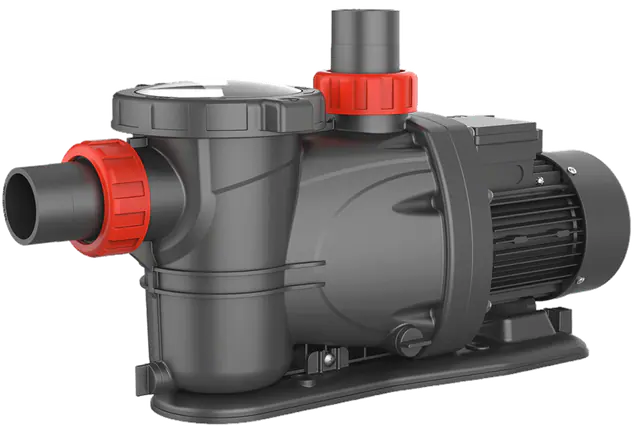
- Max flow
- 375 L/min (22.5 m³/h)
- Max head
- 15 m
- Inlet / outlet
- 2" (50 mm)
- Voltage
- 220-240 V / 50 Hz
Price on request
- Max flow
- 450 L/min (27 m³/h)
- Max head
- 17 m
- Inlet / outlet
- 2"×2" (50 mm)
- Voltage
- 220-240 V / 50 Hz
Price on request
Related categories