

Contents
Choose an air compressor in this order: first the airflow (in L/min) your tools need, then the pressure (in bar), then the tank size. Our Bison range runs from a 24 L oil-free model to a 100 L belt-driven model rated at 10 bar and 535 L/min. The 750 L/min model has a stated power of 3 × 1,500 W, so check your electrical supply or your generator before you order it.
Airflow, pressure and tank: what does each figure mean?
These three figures answer three different questions. A large tank does not make up for low airflow.
- Airflow (L/min) is the volume of air the compressor produces each minute. It decides whether a tool keeps working steadily or runs out of air.
- Pressure (bar) is how hard the stored air pushes. Most workshop air tools work at around 6 bar; check the tool's manual. A maximum of 8 or 10 bar leaves headroom above that.
- Tank size (L) is a reserve. It covers peaks in demand and lets the motor stop between cycles. It does not create air.
Leave a margin on airflow. The airflow on a datasheet is often the intake figure, and the air actually delivered at the outlet is lower. A margin of 30 to 50% above the tool's consumption is a sound starting point.
Oil-free, direct-drive or belt-driven: what is the difference?
The pump type determines how you use the compressor, how you service it and how much it weighs.
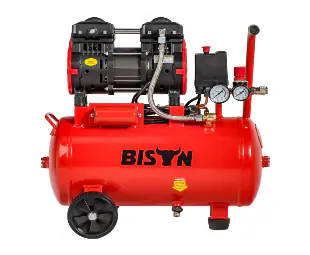
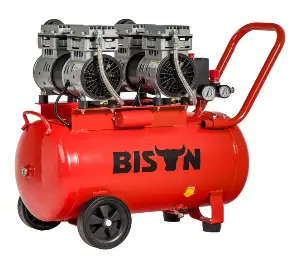
- Oil-free. The pump has no oil sump, so there is no oil to check or change and no oil mist in the air. This type suits tyre inflation, blow guns and painting. It is mainly designed for intermittent use.
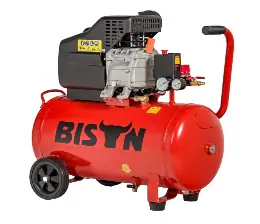
- Direct-drive. The motor drives the pump without a belt. The unit stays compact and light. It is not an oil-free model: check the oil level as the manual describes.
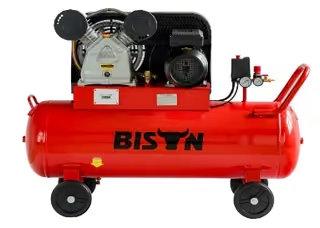
- Belt-driven. The motor drives the pump through a belt, so the pump can turn more slowly. Our datasheets give a speed of 1,400 rpm for the belt-driven model, compared with 2,800 rpm for the other models. A slower pump generally runs cooler and copes better with long sessions. The downside is that the machine is heavier and the belt tension needs regular checks.
The 5 Bison compressors in one table
All our compressors run on 220 V, 50 Hz. The values below come from their datasheets.
| Model | Type | Tank | Power | Pressure | Airflow | Weight |
|---|---|---|---|---|---|---|
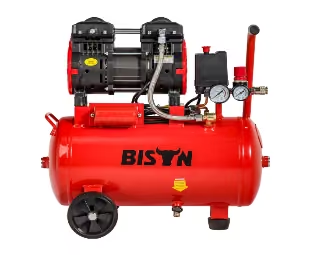
| BS-1100W-2-24 | Oil-free, silent, 1 head | 24 L | 1,100 W | Not stated | Not stated | 37 kg |
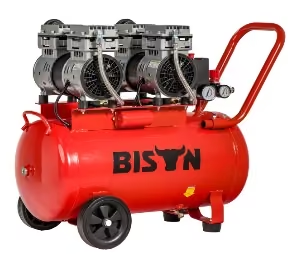
| BS-1100W-2x2-50 | Oil-free, silent, 2 heads | 50 L | 1,100 W | Not stated | Not stated | 37 kg |
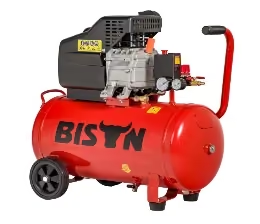
| BS-BM-2050 | Direct-drive | 50 L | 1,500 W | 8 bar | 185 L/min | 27 kg |
| BS-2065-100 | Belt-driven | 100 L | 2,200 W | 10 bar | 535 L/min | 84 kg |
| BS-1500W-2x3-100 | Oil-free, silent | 100 L | 3 × 1,500 W | 8 bar | 750 L/min | 73 kg |
The datasheets for the two BS-1100W models give neither pressure nor airflow. If those values matter for your tool, ask us before you order. Each model's dimensions are on its page, where you can download its datasheet as a PDF.
Which model for which tool?
Start from the tool that uses the most air. Its air consumption and working pressure are on its rating plate or in its manual. The needs below are typical figures: your tool's own figure always takes precedence.
- Car and motorbike tyres, blow gun, stapler. Low, occasional demand. The BS-1100W-2-24 is enough for occasional use; the BS-1100W-2x2-50 keeps more air in reserve.
- Paint spray gun. Often 150 to 350 L/min depending on the gun, and it needs clean air. An oil-free model is the better choice. For airflow in that range, look at the BS-1500W-2x3-100.
- Impact wrench, air ratchet. Demand comes in bursts, often 100 to 300 L/min. The BS-BM-2050 covers light needs; for a garage that works all day, the BS-2065-100 keeps up better.
- Air sander, air grinder, several workstations at once. Steady, high demand. Aim for a 100 L model. For continuous work, the belt-driven BS-2065-100 is the best fit; the BS-1500W-2x3-100 offers more airflow but, like oil-free models in general, is better suited to intermittent use.
- Truck and bus tyres. They are often inflated to a higher pressure than car tyres. The BS-2065-100's 10 bar maximum leaves headroom; check the pressure recommended by the tyre manufacturer.
Between 50 L and 100 L, the question is how long you use the tool. A 50 L model suits short jobs. A 100 L model suits long runs or several people using tools at once.
Can you run an air compressor on a generator?
A compressor runs on a generator under two conditions: a 220 V output (a single-phase generator, or one phase and neutral of a three-phase 380 V generator, counting the load on that phase) and enough power for start-up. Our guide Single-Phase or Three-Phase Generator: How to Choose explains the difference. A compressor motor briefly draws several times its rated power when it starts, and it restarts on every cycle.
- Add up your appliances in kW, convert to kVA (kW ÷ 0.8) and add the compressor's starting surge: a generator is rated in kVA. Our guide kVA vs kW: What Is the Difference for a Generator? shows the calculation.
- The BS-1500W-2x3-100 is rated at 3 × 1,500 W, i.e. 4,500 W in total. At 220 V, that is more than 20 A while running (4,500 W ÷ 220 V, before motor losses). A standard 16 A socket is not enough: have an electrician install a dedicated, protected circuit.
- Start the compressor before the other appliances connected to the generator, and size the generator so it can absorb a restart while everything else is running, because the compressor restarts on its own every cycle.
Our Generator Finder helps you estimate the power you need by adding the compressor to your other appliances.
Delivery, commissioning and spare parts
We deliver in Kinshasa and to the other provinces of the DRC. Lead time and cost are stated in your quote. We provide installation, maintenance, after-sales service and spare parts: see our services. You can see our equipment at our showroom, No. 26, Avenue des Huileries, Centre des Handicapés, opposite the INRB, Gombe. The full range is on the Air Compressors page; MK Energies is an authorized Bison dealer.
Ask for a quote on WhatsApp at +243 903 005 060 with the model, the tools you want to connect and their air consumption. Price on request.
Frequently asked questions
Which 100-litre air compressor should I choose in Kinshasa?
We offer two 100 L models. The belt-driven BS-2065-100 has a maximum pressure of 10 bar and a stated airflow of 535 L/min, with a 2,200 W motor. The oil-free BS-1500W-2x3-100 has a stated airflow of 750 L/min and a maximum pressure of 8 bar, but needs 3 × 1,500 W. The first suits a garage that works long hours; the second suits large volumes of clean air in intermittent use.
50 L or 100 L compressor: which one should I buy?
Buy a 50 L model for tyre inflation, blow guns and tools used in short bursts. Buy a 100 L model if the tool runs for a long time, if you paint large surfaces or if several tools work at once.
Is an oil-free compressor suitable for painting?
Yes. With no oil sump, the pump does not load the air with oil, which limits defects on the painted surface. You should still fit a filter and a water trap on the line, because compressed air carries moisture.
Can I plug a compressor into an ordinary socket?
Yes, for the 1,100 W to 2,200 W models, on a 220 V socket in good condition with proper protection. The BS-1100W-2-24 and BS-1100W-2x2-50 (1,100 W) and the BS-BM-2050 (1,500 W) plug in this way without difficulty. The 2,200 W BS-2065-100 draws more than 10 A while running, and more at start-up, so avoid long or undersized extension leads; a protected 16 A circuit is advisable. The BS-1500W-2x3-100, rated at 4,500 W in total, needs a dedicated circuit.
Sources: Bison datasheets (BS-1100W-2-24, BS-1100W-2x2-50, BS-BM-2050, BS-2065-100, BS-1500W-2x3-100); typical workshop figures for air tool consumption.
A question?
Our team answers on WhatsApp or through the contact form.
Products mentioned
- Power
- 1,100 W / 1.5 HP
- Voltage
- 220 V / 50 Hz
- Speed
- 2,800 rpm
- Weight
- 37 kg
Price on request
- Power
- 1,100 W / 1.5 HP
- Voltage
- 220 V / 50 Hz
- Speed
- 2,800 rpm
- Weight
- 37 kg
Price on request
- Power
- 1,500 W / 2 HP
- Pressure
- 8 bar
- Max flow
- 185 L/min
- Voltage
- 220 V / 50 Hz
Price on request
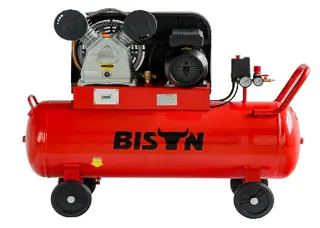
- Power
- 2,200 W / 3 HP
- Pressure
- 10 bar
- Max flow
- 535 L/min
- Voltage
- 220 V / 50 Hz
Price on request
Related categories