

Contents
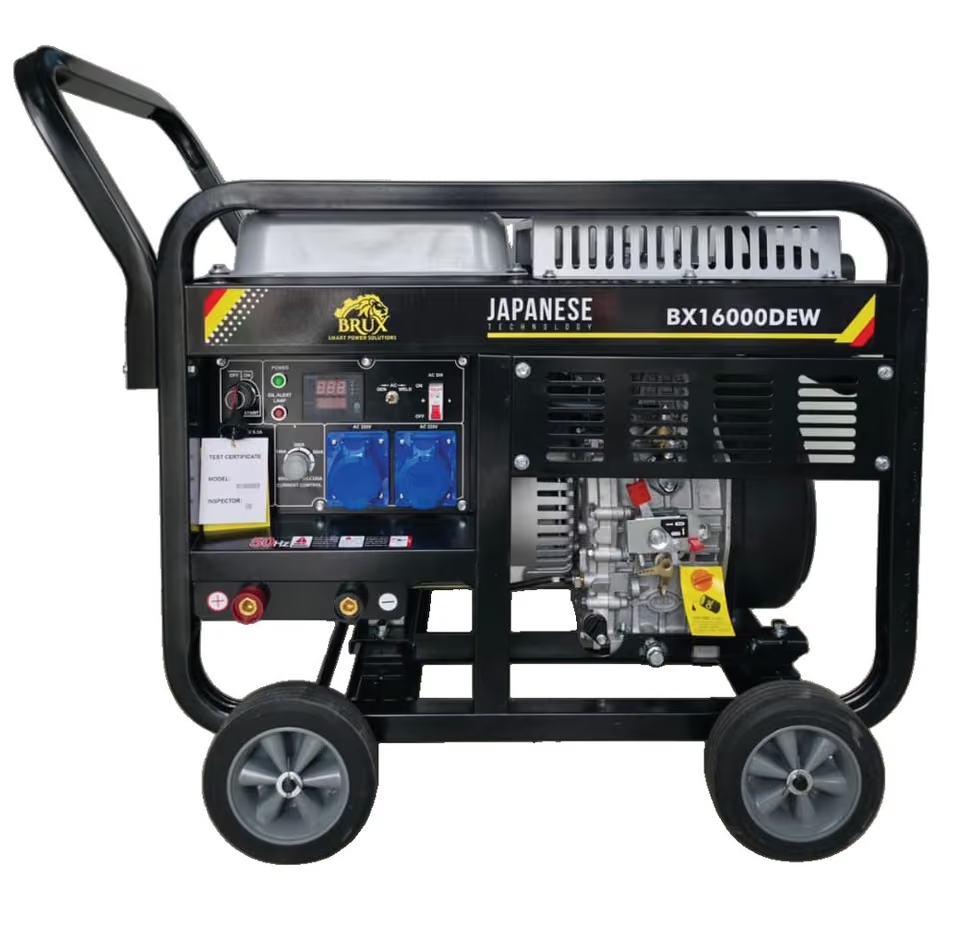
A diesel welding generator is an engine, a welding source and a small generator in one frame. Our three Brux models give 180 A, 220 A or 300 A of welding current, plus 1.8, 2.0 or 5.0 kW of 220 V power for a grinder or site lights. Pick the current for the largest electrode you use.
Welding generator or generator plus welder?
On a site with no grid power, you have two options. The first is a diesel welding generator, also called an engine-driven welder: the engine drives the welding source directly. You move one machine, with no supply cable between a generator and a welder and no power matching between the two.
The second pairs a generator with an electric welding machine. It makes sense if you already own a welder, or if the generator must also power other equipment. The generator's output then has to be well above the input power on the welder's rating plate. Also check the welder's manual: its maker should confirm that it can run on a generator and state the generator size it recommends.
| Criterion | Diesel welding generator | Generator plus welder |
|---|---|---|
| Machines to move | One | Two |
| Main use | Arc welding, small 220 V tools | Welding plus other, heavier loads |
| What to check | Maximum current against your largest electrode | Generator power against the welder's input power |
For a crew that moves from site to site (gates, window grilles, steel frames, pipework), the welding generator is the simplest option to transport and start.
What current for which electrode size?
Electrode diameter sets the range of welding current. The most common rule of thumb gives about 30 to 40 A per millimetre of diameter, for a rutile stick electrode in the flat position. It is a ballpark figure, not an exact value.
- 2.5 mm electrode: about 75 to 100 A.
- 3.2 mm electrode: about 95 to 130 A.
- 4.0 mm electrode: about 120 to 160 A.
- 5.0 mm electrode: about 150 to 200 A.
The real range depends on the coating (rutile or basic), the welding position and the thickness of the parts. The range printed on the electrode box always takes precedence: follow it.
To choose a machine, start from the largest electrode you use, then keep a margin below the maximum current. At high current, every welding machine needs rest periods to cool down: this is its duty cycle. If you plan long continuous welds, ask us about the model you have in mind.
By this general rule:
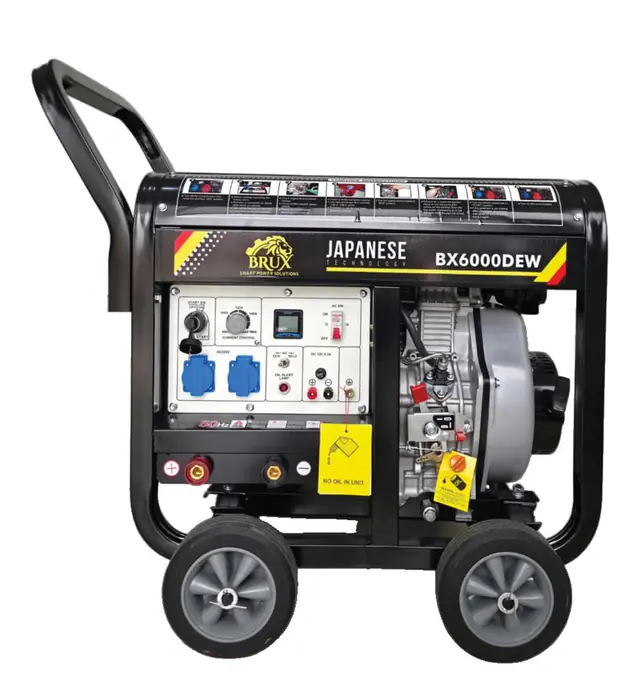
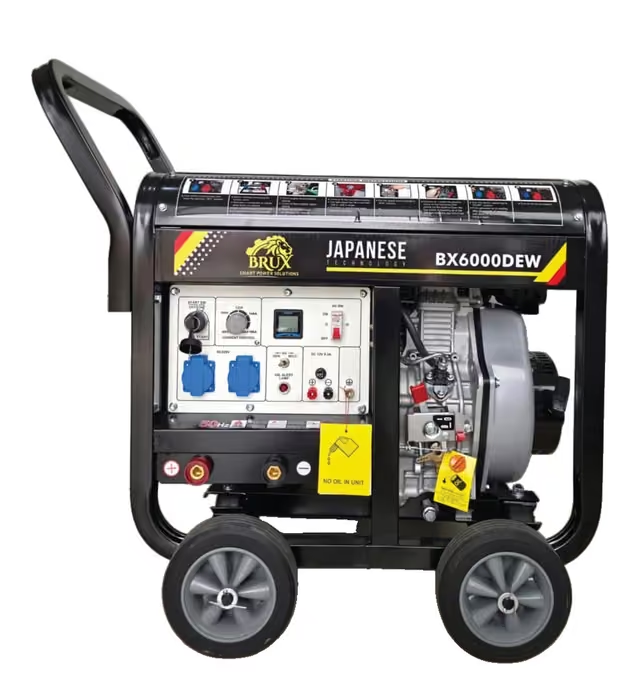
- 180 A (BX6000DEW) covers 2.5 and 3.2 mm electrodes, and 4.0 mm for occasional work.
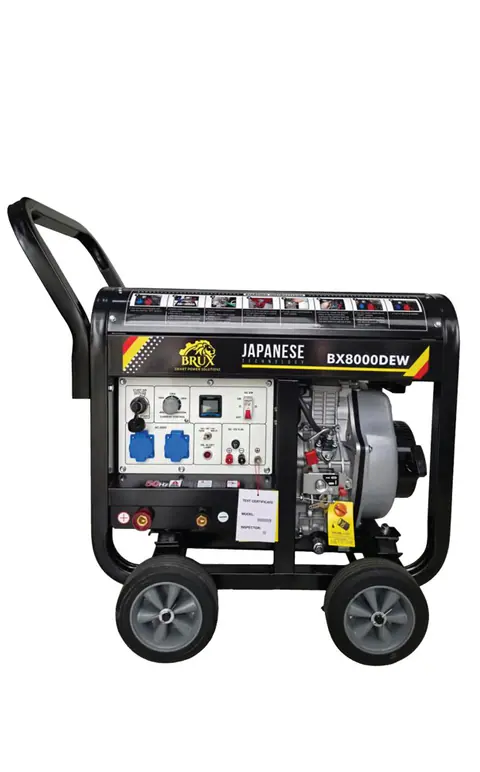
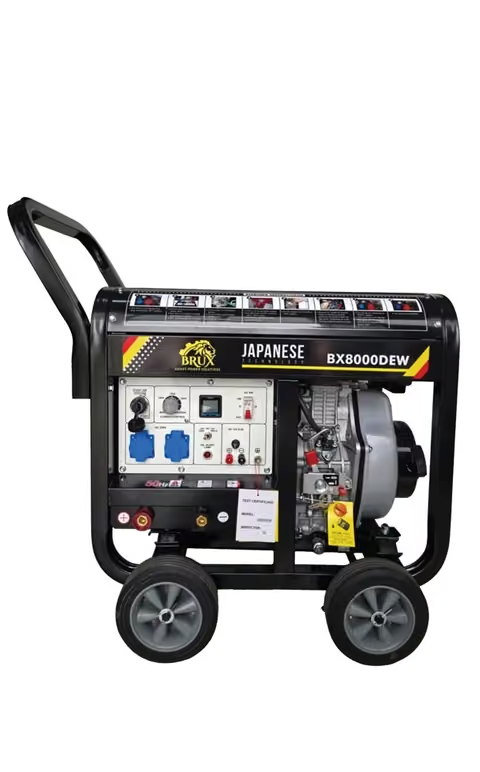
- 220 A (BX8000DEW) covers 4.0 mm with a margin.
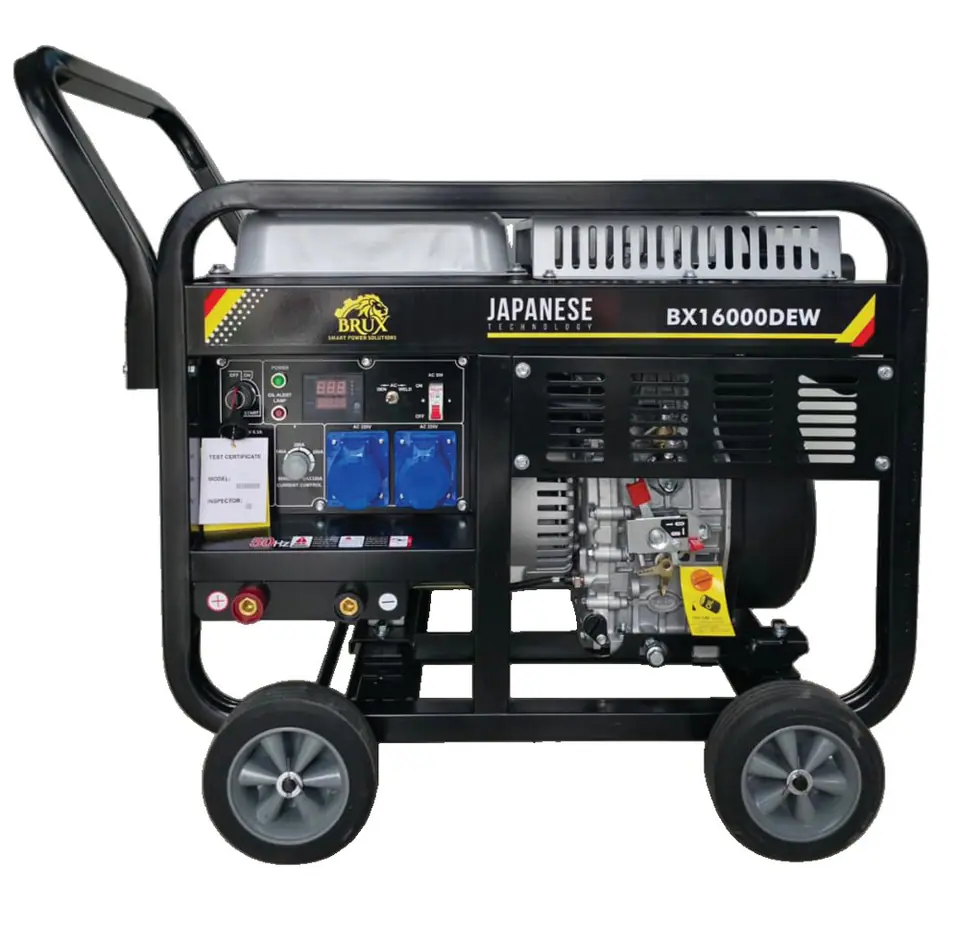
- 300 A (BX16000DEW) covers 5.0 mm with a margin, for structural steel and thick plate.
Whoever does your welding remains the best judge of your usual jobs.
The three Brux models at a glance
All three are open-frame diesel welding generators with electric start. Their generator output, also called the auxiliary output, supplies 220 V single-phase, 50 Hz.
| Model | Welding current | 220 V generator output | Diesel engine | Battery | Display |
|---|---|---|---|---|---|
| Brux BX6000DEW | 180 A | 1.8 kW | 186FA | 30 Ah | 3-in-1 |
| Brux BX8000DEW | 220 A | 2.0 kW | 192FB | 30 Ah | 3-in-1 |
| Brux BX16000DEW | 300 A | 5.0 kW | 1105FD | 36 Ah | 5-in-1 |
Values from our datasheets. Each product page links to the model's PDF datasheet.
The BX16000DEW stands out for more than its current. Its generator output reaches 5.0 kW, compared with 1.8 and 2.0 kW for the other two. If you plan to run a large grinder or several floodlights, that figure matters as much as the amperage.
See all our diesel welding generators and the Brux range; MK Energies & Services is an authorized Brux dealer.
What can you plug into the auxiliary output?
The auxiliary output supplies 220 V single-phase, up to 1.8 kW (BX6000DEW), 2.0 kW (BX8000DEW) or 5.0 kW (BX16000DEW). Add up the power of everything plugged in at the same time, as shown on each rating plate, and stay below that limit.
Typical figures, to check against your own tools' rating plates:
- a 125 mm grinder: often 800 to 1,400 W;
- a 230 mm grinder: often 2,000 W or more, so too much for the two smaller models once the starting surge is counted;
- a drill: often 500 to 1,000 W;
- an LED site floodlight: from a few tens to a few hundred watts.
Electric motors draw more current when they start. A compressor or pump motor briefly draws several times its rated current (often 3 to 7 times for a direct-on-line motor). Keep a margin. Our guide kVA vs kW: What Is the Difference for a Generator? explains starting surge and power factor.
Do not count on the full auxiliary output while you weld at high current: the same engine drives both. If you need to weld and run a tool at the same time, say so in your quote request.
Safety and ventilation on site
A diesel welding generator gives off carbon monoxide, an odourless and deadly gas. Always run it outdoors or in a well-ventilated place, with the exhaust pointing away from people.
- Never run it in an enclosed room, a container or a trench without fresh air.
- Set the machine on flat, stable ground, away from flammable materials.
- Keep fuel and jerrycans away from the welding area: spatter can ignite them.
- Refuel with the engine stopped and cool.
- Keep cables and the 220 V output out of rain and puddles.
- Give the welding operator a suitable welding helmet, gloves and protective clothing that covers the skin, and keep them out of the fumes.
For siting, the mounting base and ventilation of any generator, see our guide Installing a Generator Safely.
Delivery, commissioning and spare parts
We deliver within Kinshasa and to the other provinces of the DRC. Give the destination city in your quote request. See also Delivering a Generator to the DRC Provinces: What to Plan. We provide commissioning, maintenance, after-sales service and spare parts: see our services. Our showroom is at No. 26, Avenue des Huileries, Gombe, opposite the INRB.
Ask for a quote on WhatsApp at +243 903 005 060 with the model, the size of your largest electrode and the tools you want to plug in. Price on request.
Frequently asked questions
Engine-driven welder, welding generator, diesel welder: are they the same machine?
Yes. All three terms describe a machine whose engine drives a welding source. Our Brux models add a 220 V generator output for a tool or lighting.
Which model for gates and window grilles?
This work is often done with 2.5 or 3.2 mm electrodes. By the general rule of 30 to 40 A per millimetre, 180 A is enough: that is the BX6000DEW. For structural steel, choose the BX8000DEW for 4.0 mm electrodes and the BX16000DEW for 5.0 mm electrodes.
How does a Brux welding generator start?
With an electric starter, powered by a 30 Ah battery (BX6000DEW and BX8000DEW) or a 36 Ah battery (BX16000DEW). Keep the battery charged and its terminals clean, especially if the machine stands idle for long periods.
Can the BX16000DEW run a 230 mm grinder?
Usually, yes. Its 220 V output goes up to 5.0 kW, and a 230 mm grinder often draws 2,000 W or more. Check your grinder's rating plate, and do not count on the full power of the auxiliary output while you weld at high current. The BX6000DEW (1.8 kW) and BX8000DEW (2.0 kW) are not enough.
Sources: MK Energies & Services datasheets for the Brux BX6000DEW, BX8000DEW and BX16000DEW; general workshop rule for stick electrode current.
A question?
Our team answers on WhatsApp or through the contact form.
Products mentioned
- Generator output
- 1.8 kW
- Engine
- Diesel 186FA
- Starting
- Electric
- Voltage
- 220 V, single-phase, 50 Hz
Price on request
- Generator output
- 2.0 kW
- Engine
- Diesel 192FB
- Starting
- Electric
- Voltage
- 220 V, single-phase, 50 Hz
Price on request
- Generator output
- 5.0 kW
- Engine
- Diesel 1105FD
- Starting
- Electric
- Voltage
- 220 V, single-phase, 50 Hz
Price on request
Related categories