

Contents
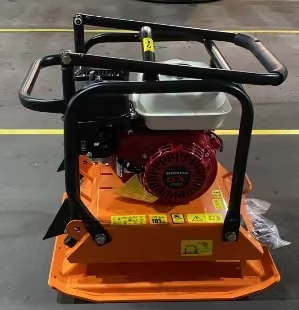
Use a rammer for trenches and clay soils, a plate compactor for sand, gravel, paving sub-bases and laid pavers, and a roller for larger areas such as a yard or an access road. Our Bison range covers all three: two plate compactors with compaction depths of 20 and 30 cm, two rammers rated at 10 and 11 kN, and a diesel roller with a 425 mm drum.
Which soil needs which machine?
Soil type, more than job size, decides which machine you need. Granular soil (sand, gravel, crushed fill) settles under vibration: the grains shift and fill the gaps. Cohesive soil (clay, silty earth) sticks together and holds water: it needs impact to drive the air out and pack it tight.
- Granular soil, open area: plate compactor (sub-base under a terrace slab, paved car park, sub-base under pavers).
- Cohesive soil or tight space: rammer (pipe trench, backfill along a wall or around a manhole).
- Large open area to compact: roller (yard, access road, small asphalt patch).
On sandy ground, common in Kinshasa, a plate compactor is often the right machine. In low-lying clay areas, a rammer works better. On clay, a plate tends to bounce without compacting deep down.
| Model | Type | Force | Key figure | Typical use |
|---|---|---|---|---|
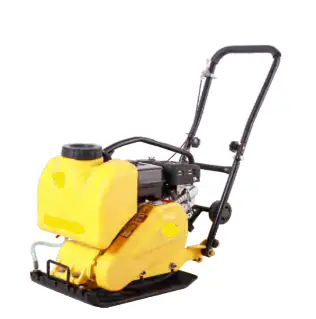
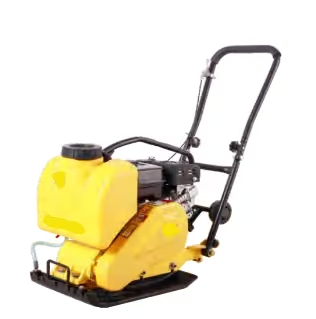
| Bison BSHC60 | Plate compactor | 10.5 kN | 20 cm depth, 50 × 36 cm plate | Paving sub-bases, small slabs |
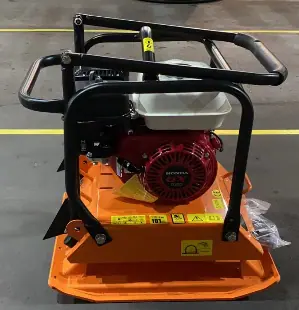
| Bison BSHC90 | Plate compactor | 13 kN | 30 cm depth, 660 m²/h | Terraces, car parks, sub-base |
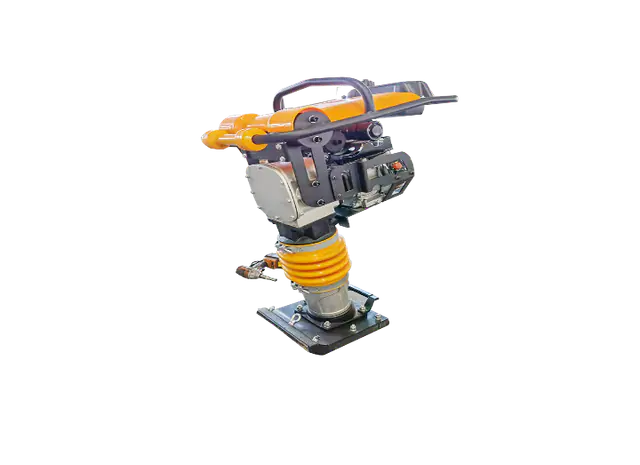
| Bison BSHRM100 | Tamping rammer | 10 kN | 320 × 280 mm shoe, 80 kg | Trenches, along walls |
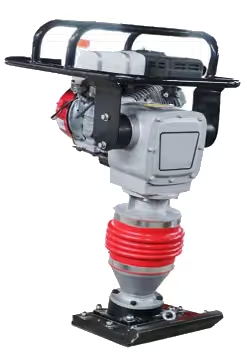
| Bison BSHRM110 | Tamping rammer | 11 kN | 320 × 280 mm shoe, 100 kg | Trenches, clay soils |
| Bison BS-YLS600B | Vibratory roller | 2 × 20 kN | 425 mm drum, 460 kg | Yards, driveways, small asphalt patches |
Figures from the Bison datasheets. Force means compaction force (plates), impact force (rammers) or excitation force (roller).
Plate compactors: what depth and what output?
Compaction depth is the maximum layer thickness the plate can compact effectively, over several passes. The greater it is, the more material you can spread at a time.
- The BSHC60 delivers 10.5 kN at 5,600 vibrations per minute. It compacts down to 20 cm, with a 50 × 36 cm plate and a Loncin engine. It suits small areas and laid pavers.
- The BSHC90 delivers 13 kN at 5,500 vibrations per minute. It compacts down to 30 cm, with a 57 × 44 cm plate and a Loncin engine. Its datasheet states an output of 660 m² per hour.
The datasheet does not state the number of passes. Assuming the figure is for one pass, 3 to 4 passes over a 200 m² yard come to about 55 to 73 minutes of actual work with the BSHC90, excluding moves and breaks.
For interlocking pavers, compact the sub-base (gravel or crushed fill), then screed the sand bedding layer without compacting it. Lay the pavers, compact them with a paving pad under the plate, sweep sand into the joints and make a final pass. Ask us whether a paving pad is available for your model.
Rammers: how much force for a trench?
A tamping rammer, also called a jumping jack, strikes the ground with a narrow shoe. It works where a plate cannot go: in a trench, along a wall, around a post.
Both our models have a 3.7 kW (5 HP) engine and a 320 × 280 mm shoe. They deliver 460 to 650 blows per minute, with a stroke of 45 to 70 mm. They travel at 10 to 13 m per minute and carry a 2 L fuel tank.
- The BSHRM100 delivers 10 kN of impact force and weighs 80 kg.
- The BSHRM110 delivers 11 kN and weighs 100 kg. The extra force and weight help on dense clay or deep backfill.
The trench must be wider than the shoe, with some room to guide the machine. To open a trench through a slab or asphalt before laying a pipe, see our cutting equipment: the Bison BSH500-190 floor saw cuts from 1 to 18 cm deep.
The BS-YLS600B roller: for which areas?
The BS-YLS600B is a walk-behind vibratory roller, steered by an operator on foot. Weighing 460 kg, with a travel speed of 0 to 4 km/h, it is built for open areas: yards, driveways, small asphalt patches.
- 173FE diesel engine, 4-stroke, single-cylinder, air-cooled: 5.5 HP at 3,600 rpm.
- Excitation force of 2 × 20 kN, 75 Hz frequency, 0.5 mm amplitude.
- Drum 425 mm wide and 426 mm in diameter.
- Travel speed 0 to 4 km/h, gradeability 30%.
- 20 L water tank, 3.5 L fuel tank, weight 460 kg.
The water tank wets the drum while it works. On asphalt, the water stops the hot material from sticking to the drum. Our range does not include a multi-tonne roller. For heavy road work, describe the project to us and we will tell you whether the BS-YLS600B is suitable.
How do you compact in layers?
Compact layer by layer: a layer that is too thick stays loose at the bottom, even if the surface feels hard. The rules below are common site practice: adapt them to your soil and your specification.
- Limit the layer thickness. Do not exceed the compaction depth on the datasheet: 20 cm for the BSHC60, 30 cm for the BSHC90. Ideally, stay slightly below it.
- Check the moisture. Squeeze a handful of material. It should hold its shape without water running out. If it is too dry, the soil will not pack down; if it is waterlogged, it turns to mud. In the rainy season, let soaked backfill drain first.
- Make several passes. Plan on 3 to 4 overlapping passes. Stop when the machine leaves almost no mark.
- Protect pipes and cables. In a trench, first cover the pipe with a layer of sand compacted by hand. Never ram directly on it.
- Think about safety. Wear safety boots and hearing protection. The engine gives off carbon monoxide: in a deep trench or a confined space, make sure there is good ventilation.
Delivery, commissioning and spare parts
We deliver in Kinshasa and to the other provinces of the DRC; delivery terms are set out in your quote. We provide commissioning, maintenance, after-sales service and spare parts: see our Services page. The Bison catalogue is available on the Downloads page. MK Energies & Services is an authorized Bison dealer: see the full Bison range and all our compaction equipment. Our showroom is at No. 26 Avenue des Huileries, Gombe, opposite the INRB.
Ask for a quote on WhatsApp at +243 903 005 060 with your soil type, the area or trench length, and the thickness to compact. Price on request.
Frequently asked questions
Rammer or plate compactor for a trench?
A rammer. Its 320 × 280 mm shoe fits a narrow trench, and its blows pack clay backfill tight. A plate compactor is better for open areas and sandy soil.
Can you compact pavers with a plate compactor?
Yes. The plate first compacts the sub-base. The sand bedding layer is screeded without being compacted, then the plate passes over the laid pavers. On pavers, a paving pad stops the paver surface from chipping.
Do these compactors need electricity?
No. Each machine has its own combustion engine. The BS-YLS600B roller, for example, has a 173FE diesel engine. So these compactors suit sites with no grid power.
Sources: Bison datasheets (BSHC60, BSHC90, BSHRM100, BSHRM110, BS-YLS600B); common site practice for layer compaction and paver laying.
A question?
Our team answers on WhatsApp or through the contact form.
Products mentioned
Compaction equipment
Bison plate compactor BSHC60
- Compacting force
- 10.5 kN
- Compaction depth
- 20 cm
- Working weight
- 65 kg
- Engine
- LONCIN
Price on request
Compaction equipment
Bison plate compactor BSHC90
- Compacting force
- 13 kN
- Compaction depth
- 30 cm
- Working weight
- 78 kg
- Engine
- LONCIN
Price on request
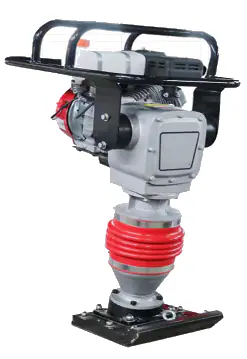
- Impact force
- 10 kN
- Power
- 5 HP / 3.7 kW
- Weight
- 80 kg
Price on request
- Impact force
- 11 kN
- Power
- 5 HP / 3.7 kW
- Weight
- 100 kg
Price on request
Related categories