

Contents
According to the datasheets of our Perkins-engine sets, a 20 kVA generator uses 5.3 L/h at full load, a 100 kVA set 22.6 L/h and a 500 kVA set 100 L/h. At 75% load, allow about 80% of these figures. Multiply by your running hours to get your daily consumption.
How much fuel does a diesel generator use for its size?
At full load, our diesel sets with Perkins engines use from 3.7 L/h for the 13 kVA set to 442 L/h for the 2,000 kVA set. The table gives each datasheet value, two part-load estimates and the runtime on the tank of the soundproof version.
| Power (kVA) | Perkins engine | L/h at 100% (datasheet) | L/h at 75% (estimate) | L/h at 50% (estimate) | Soundproof tank | Runtime at 100% | Runtime at 75% |
|---|---|---|---|---|---|---|---|
| 13 | 403A-15G1 | 3.7 | 3.0 | 2.3 | 45 L | 12.2 h | 15.0 h |
| 15 | 403A-15G2 | 5.0 | 4.1 | 3.1 | 45 L | 9.0 h | 11.1 h |
| 20 | 404A-22G1 | 5.3 | 4.3 | 3.3 | 55 L | 10.4 h | 12.8 h |
| 30 | 1103A-33G | 7.2 | 5.9 | 4.5 | 120 L | 16.7 h | 20.5 h |
| 45 | 1103A-33TG1 | 10.7 | 8.7 | 6.7 | 120 L | 11.2 h | 13.8 h |
| 60 | 1103A-33TG2 | 14.0 | 11.4 | 8.8 | 120 L | 8.6 h | 10.5 h |
| 80 | 1104A-44TG2 | 18.7 | 15.2 | 11.7 | 205 L | 11.0 h | 13.5 h |
| 100 | 1104C-44TAG2 | 22.6 | 18.4 | 14.1 | 205 L | 9.1 h | 11.2 h |
| 135 | 1106A-70TG1 | 30.3 | 24.6 | 18.9 | 340 L | 11.2 h | 13.8 h |
| 150 | 1106A-70TAG2 | 33.4 | 27.1 | 20.9 | 340 L | 10.2 h | 12.5 h |
| 180 | 1106A-70TAG3 | 34.8 | 28.3 | 21.8 | 340 L | 9.8 h | 12.0 h |
| 200 | 1106A-70TAG4 | 45.8 | 37.2 | 28.6 | 340 L | 7.4 h | 9.1 h |
| 300 | 1506A-E88TAG5 | 64.9 | 52.7 | 40.6 | 440 L | 6.8 h | 8.3 h |
| 350 | 2206A-E13TAG2 | 71.0 | 57.7 | 44.4 | 740 L | 10.4 h | 12.8 h |
| 400 | 2206A-E13TAG3 | 81.0 | 65.8 | 50.6 | 740 L | 9.1 h | 11.2 h |
| 450 | 2506A-E15TAG1 | 95.0 | 77.2 | 59.4 | 740 L | 7.8 h | 9.6 h |
| 500 | 2506A-E15TAG2 | 100.0 | 81.2 | 62.5 | 740 L | 7.4 h | 9.1 h |
| 600 | 2806A-E18TAG1A | 123.0 | 99.9 | 76.9 | 820 L | 6.7 h | 8.2 h |
| 750 | 4006-23TAG2A | 157.0 | 127.6 | 98.1 | n/s | n/s | n/s |
| 800 | 4006-23TAG3A | 172.0 | 139.8 | 107.5 | n/s | n/s | n/s |
| 1,000 | 4008-30TAG2 | 213.0 | 173.1 | 133.1 | n/s | n/s | n/s |
| 1,000 | 4008-TAG2A | 215.0 | 174.7 | 134.4 | n/s | n/s | n/s |
| 1,250 | 4012-46TWG2A | 259.0 | 210.4 | 161.9 | n/s | n/s | n/s |
| 1,500 | 4012-46TAG2A | 301.0 | 244.6 | 188.1 | n/s | n/s | n/s |
| 2,000 | 4016-61TRG2 | 442.0 | 359.1 | 276.2 | n/s | n/s | n/s |
Simplified estimate used by our finder; actual consumption depends on the engine, the load and maintenance. The estimate uses the formula: L/h at a given load = L/h at 100% × (0.25 + 0.75 × load). At 75% load the factor is 0.81; at 50% it is 0.625.
n/s: not stated. The datasheet lists no tank for these sizes; plan an external tank. The 135 kVA datasheet gives 30.28 L/h, rounded here to 30.3. The 450 kVA set is rated at 455 kVA prime power on its datasheet.
The three sets quoted at the top are the 20 kVA set with a 404A-22G1 engine, the 100 kVA set with a 1104C-44TAG2 engine and the 500 kVA set with a 2506A-E15TAG2 engine. See every model in our diesel generator range. To see which engine powers each set from 13 to 2,000 kVA, check our Perkins engine table.
How do you work out daily fuel use?
Daily fuel use is the hourly consumption multiplied by the number of running hours. The method, in three steps:
- Estimate the generator's average load as a percentage of its rating.
- Read the matching hourly consumption in the table.
- Multiply it by the number of running hours per day.
Example: a 100 kVA set at 75% load uses about 18.4 L/h. For 10 hours a day: 18.4 L/h × 10 h = 184 litres a day. Over 30 days that comes to about 5,520 litres.
To know the load, you first need to know your power requirement. Our finder lets you work out your generator size from your appliances.
How long does a tank last?
Runtime is the tank capacity divided by the hourly consumption. A 20 kVA soundproof set has a 55 L tank: it runs about 10.4 hours at full load and 12.8 hours at 75%.
The open-frame version has a different tank: 65 L for the 20 kVA set and 150 L for the 100 kVA set. Check the datasheet of the version you choose. For long outages, our finder recommends an external fuel tank to extend runtime. To plan your power during load-shedding, see our guide Power cuts in Kinshasa: how to keep the lights on at home or at work.
How do you estimate the fuel cost?
The fuel cost is the number of litres used multiplied by the diesel price. That price changes often, so use the current pump price.
Back to the 100 kVA example: 184 litres a day × price per litre = fuel cost per day. Add oil and filters, replaced at the intervals in the engine manual.
How can you reduce a generator's fuel use?
A well-sized, well-maintained generator uses less fuel for the same work. Good practice:
- Choose the right size: an oversized set runs at low load.
- Avoid long hours at very low load, below about 30%: the engine burns fuel incompletely and builds up carbon deposits. Our guide to the oversized generator explains why.
- Service the air and fuel filters at the intervals in the engine manufacturer's manual.
- Use clean fuel, stored in a closed tank.
- For small night-time loads, consider a second, smaller set.
Our team handles maintenance and spare parts. Our guide Generator maintenance sets out the maintenance schedule.
Estimate the fuel use of your future generator
For each Perkins-engine set it suggests, our finder shows the estimated consumption and runtime at your load. Use it to work out your generator size: it compares your need with our range from 13 to 2,000 kVA.
For a house, start with our guide What size generator for a house in Kinshasa?.
Frequently asked questions
Does a generator use half as much fuel at half load?
No. According to our finder's estimate, a set at 50% load uses about 62.5% of its full-load consumption. A 100 kVA set goes from 22.6 to 14.1 L/h.
Where can I find the exact consumption of a model?
On its datasheet, available on each generator's page. The figure given is the full-load value.
Sources: manufacturers' datasheets (Perkins engines), MK Energies & Services finder calculation method.
A question?
Our team answers on WhatsApp or through the contact form.
Products mentioned
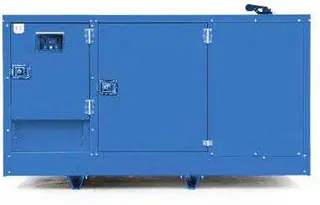
- Fuel at 100%
- 5.3 L/h
- Tank, soundproof
- 55 L
- Sound level
- 75 dBA
- Weight, soundproof
- 950 kg
- Soundproof or open skid
Price on request
- Fuel at 100%
- 22.6 L/h
- Tank, soundproof
- 205 L
- Sound level
- 75 dBA
- Weight, soundproof
- 1,920 kg
- Soundproof or open skid
Price on request
- Fuel at 100%
- 100 L/h
- Tank, soundproof
- 740 L
- Sound level
- 79 dBA
- Weight, soundproof
- 5,900 kg
- Soundproof or open skid
Price on request
Related categories