

Contents
A diesel engine that runs for long periods at a small fraction of its rating burns its fuel incompletely. Soot and unburnt fuel build up in the engine and the exhaust. Engine makers generally advise against running for long periods below about 30% load; check your engine manual. On our 100 kVA set (80 kW prime), 30% is 24 kW.
What happens inside a lightly loaded diesel engine?
A diesel engine needs heat to burn its fuel properly. It has no spark plug: hot compressed air ignites the injected fuel. At light load, the engine receives little fuel and the cylinders are not hot enough for all the fuel to burn.
The unburnt fuel mixes with soot and oil and forms deposits:
- on the injectors, which spoils the fuel spray;
- on the valves and in the exhaust manifold;
- in the silencer, where a black, oily liquid can seep from the joints.
This is known as “wet stacking”: the exhaust stack is wet with fuel and oil. With low pressure in the cylinders, the piston rings also seal less well. Oil can then reach the combustion chamber, and fuel can dilute the engine oil.
The problem builds up gradually, at a pace that depends on the engine, its use and its servicing. There is no fixed number of hours that applies to every generator.
At what percentage does load count as “low”?
There is no single threshold. Diesel engine makers generally recommend avoiding long periods below about 30% of the set's rating. Some manuals give a different figure, or a maximum time at light load. The figure that counts is the one in your engine manual.
Work out the percentage in kW, against the set's prime power (PRP), not its standby power: 10 kW on a 100 kVA set is 12.5% of its 80 kW. Our guide kVA vs kW explains the conversion.
Worked examples: what is 30% of 20, 60, 100 and 200 kVA?
On our Perkins-engined sets, 30% of prime power ranges from 4.8 kW on the 20 kVA set to 48 kW on the 200 kVA set.
| Generator | Perkins engine | Prime power (datasheet) | Standby power (datasheet) | 30% of prime power |
|---|---|---|---|---|
| 20 kVA | 404A-22G1 | 20 kVA · 16 kW | 22.3 kVA · 17.8 kW | 4.8 kW |
| 60 kVA | 1103A-33TG2 | 60 kVA · 48 kW | 66 kVA · 52.8 kW | 14.4 kW |
| 100 kVA | 1104C-44TAG2 | 100 kVA · 80 kW | 110 kVA · 88 kW | 24 kW |
| 200 kVA | 1106A-70TAG4 | 200 kVA · 160 kW | 220 kVA · 176 kW | 48 kW |
Example: a load-shedding night on a 100 kVA or a 20 kVA set
Take a night load built from our finder's default values:
| Appliances running at night | Power |
|---|---|
| 20 × 100 W lights | 2,000 W |
| 2 × 300 W fridges | 600 W |
| 1 × 400 W freezer | 400 W |
| 2 × 120 W TVs | 240 W |
| 2 × 200 W computers | 400 W |
| 1 × 1,500 W air conditioner | 1,500 W |
| Total, all running | 5.14 kW |
| Generator | Load (% of prime power) | Estimated consumption | Over 10 hours |
|---|---|---|---|
| 100 kVA (80 kW) | 6.4% | 6.7 L/h | 67 L |
| 20 kVA (16 kW) | 32% | 2.6 L/h | 26 L |
Estimate using our finder's simplified curve, extended here below 40% load: L/h ≈ L/h at 100% × (0.25 + 0.75 × load). The full-load figures come from the datasheets: 22.6 L/h for the 100 kVA set and 5.3 L/h for the 20 kVA set. The finder itself does not estimate below 40% load, so treat these figures as indicative. Real consumption depends on the engine and its condition. See our generator fuel consumption table.
On the 100 kVA set, this load stays at 6.4%: far below 30%. The same load takes 32% of the 20 kVA set, which burns about 26 L instead of 67 L over the night. Without the air conditioner, the load drops to 3.64 kW, or 23%: even a better-sized set dips below the guideline at times. What you should avoid is long hours at light load.
How do you avoid the problem?
Size the set to your actual load, plan a smaller set for quiet hours, and run the set under load as its manual specifies.
- Size to the actual load. Our finder adds up your appliances, adds a 25% reserve and checks the starting surge of the largest electric motor. Use it to work out your generator size instead of “going big”. For a home, see also What Size Generator for a House in Kinshasa?.
- Split day and night. If your needs vary a lot, one large set for working hours and one small set for the night often beat a single set. Two examples from our range:
- the Brux BX11000DSE3-3D, a 9.4 kVA (7.5 kW) three-phase silent diesel: the example load would take 69% of it in total. This set is rated for a balanced load, about 2.5 kW per phase. A single-phase air conditioner loads one phase only, and so does its start-up surge: have an electrician check how the circuits are split across the three phases;
- the Bison BS6250iE, a 5.0 kW (5.5 kW max) single-phase petrol inverter set: without the air conditioner, the example load (3.64 kW) would take 73% of it. It suits lighting, fridges and electronics, not the full 5.14 kW load, which would exceed its 5.0 kW. Switching between two sets needs a changeover switch installed by a qualified electrician; have the choice confirmed by our team.
- Run the set under load regularly. For a set that often runs lightly loaded, many manuals call for regular periods at higher load: follow the duration and load level they give. Connect real loads during these periods, such as the pump that fills your water tank, or have a technician with a load bank carry out the test. Our guide Generator Maintenance describes the monthly load test.
- Rent for a one-off need. For a building site or an event, generator rental saves you buying a set that is too large for everyday use.
What warning signs should you look for?
Have your set checked if you notice any of these signs:
- a black, oily liquid at the exhaust or silencer joints;
- more smoke than usual, especially when the load increases;
- rising oil consumption;
- a smell of diesel at the exhaust;
- an engine that struggles to take the load.
These signs can have other causes. Our guide Generator Won't Start, Stalls or Smokes Black goes through the causes to check. Our team handles maintenance and after-sales service and supplies spare parts.
Frequently asked questions
Is it a problem to let a set idle for a few minutes?
No, as long as it stays short. Manuals usually call for a short warm-up before applying load and a cool-down before stopping. The problem is long hours at no load or near it.
Can a set clogged by light-load running be restored?
It depends on the engine's condition. In mild cases, a run under load as the manual specifies and a full service can be enough. In advanced cases, the injectors or the exhaust need work. Only a technician can judge, after an inspection.
Are petrol and inverter generators affected?
The problem is mainly described for diesel engines. An inverter generator usually adjusts its engine speed to the load. Our guide Diesel, Petrol or Inverter Generator compares the three technologies.
Should I buy a bigger set to allow for future growth?
Only within reason. The finder already adds a 25% reserve. If you expect a large expansion, adding a second set when the time comes is often better than running a big set at light load for years. See our water-cooled diesel generators from 13 to 2,000 kVA.
Ask for a quote on WhatsApp at +243 903 005 060: send the list of your appliances and your running hours, and our team will suggest the right size. Prices on request.
Sources: datasheets of the Perkins-engined, Brux and Bison generators; MK Energies & Services finder calculation method and the finder's simplified fuel curve; general guidance from diesel engine makers (your engine manual takes precedence).
A question?
Our team answers on WhatsApp or through the contact form.
Products mentioned
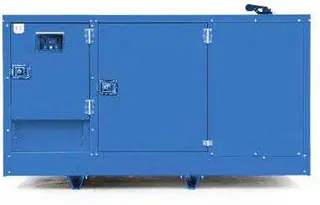
- Fuel at 100%
- 5.3 L/h
- Tank, soundproof
- 55 L
- Sound level
- 75 dBA
- Weight, soundproof
- 950 kg
- Soundproof or open skid
Price on request
- Fuel at 100%
- 14 L/h
- Tank, soundproof
- 120 L
- Sound level
- 75 dBA
- Weight, soundproof
- 1,550 kg
- Soundproof or open skid
Price on request
- Fuel at 100%
- 22.6 L/h
- Tank, soundproof
- 205 L
- Sound level
- 75 dBA
- Weight, soundproof
- 1,920 kg
- Soundproof or open skid
Price on request
- Fuel at 100%
- 45.8 L/h
- Tank, soundproof
- 340 L
- Sound level
- 77 dBA
- Weight, soundproof
- 2,650 kg
- Soundproof or open skid
Price on request
Related categories