

Contents
Every time water rises 10 m, it loses about 1 bar of pressure, and one floor is about 3 m high. If water reaches your tank but runs weakly at the taps, the usual fix is a booster pump on the tank outlet. If water has to be lifted from a ground tank to a roof tank, you need a peripheral or jet pump whose maximum head covers the lift, with a margin.
To compare every pump family, read our guide Which Water Pump for a House in Kinshasa?
Where does low water pressure come from?
Three causes come up, each with its own fix.
- Mains water does not arrive, or arrives on and off. At the end of March 2026, the NGO La Voix des Sans-Voix reported taps running dry for weeks in Makala, Selembao, Kisenso and Mont-Ngafula (Radio Okapi, 31 March 2026). You first need to store water in a tank.
- The tank sits too low compared with the taps. Water flows down by gravity: less height means less pressure. Upper floors are the typical case.
- The pipework slows the water down. A long, narrow or scaled pipe, or a half-closed valve, causes friction losses. Have a plumber check it before you buy a pump.
If only the top floor lacks pressure, the cause is height. If every tap lacks pressure, check the tank and the pipes.
Height and pressure: how does the 10 m per bar rule work?
A 10 m column of water exerts about 1 bar of pressure. Under a tank, the pressure at a tap depends on the height between the water level and that tap.
Worked example. A three-level house (ground floor plus two floors) has its tank on the roof. The roof is about 9 m above the ground (3 levels of 3 m). With the stand and the tank itself, the water level sits at about 11 m.
- Ground-floor tap, 1 m above the ground: 10 m of height, about 1 bar.
- Second-floor tap, 7 m above the ground: 4 m of height, about 0.4 bar before losses.
As a guide, a comfortable shower needs 1.5 to 2 bar, or 15 to 20 m of height. The second floor is far from that: you need a pump.
Case 1: low pressure at the taps under a high tank
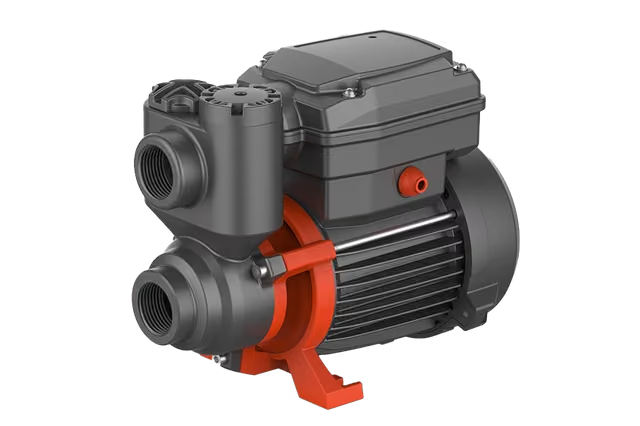
The fix is an automatic booster pump on the outlet of the tank that feeds the house. It starts when a tap opens and stops when it closes.
The LEO PQ50E-1 booster pump has a 0.37 kW motor. Its datasheet lists a maximum head of 30 m (about 3 bar, reached at near-zero flow) and a maximum flow of 33 L/min. Voltage: 180–220 V / 50 Hz.
- Preferably after a tank that sits above the pump or level with it. It can also run on the mains, but it would run dry whenever the mains supply stops.
- No hot water: its datasheet limits water temperature to 40 °C.
- Stay within its flow: 33 L/min suits one home. For several bathrooms at once, see Case 3.
See all our booster pumps.
Case 2: lifting water from a ground tank to a roof tank
You need a peripheral or jet pump whose maximum head is well above the height to lift. A pump reaches its maximum head at near-zero flow. The bigger the margin, the more flow the pump still delivers at the head you need.
Work out the head: from the water level in the ground tank to the inlet of the roof tank, plus friction losses (pipe length, elbows, valves). Example: a four-level house (ground floor plus three floors) stands 4 × 3 m = 12 m high; the stand and the tank add about 3 m, which gives 15 m to the tank inlet, before losses.
Pick the pump family.
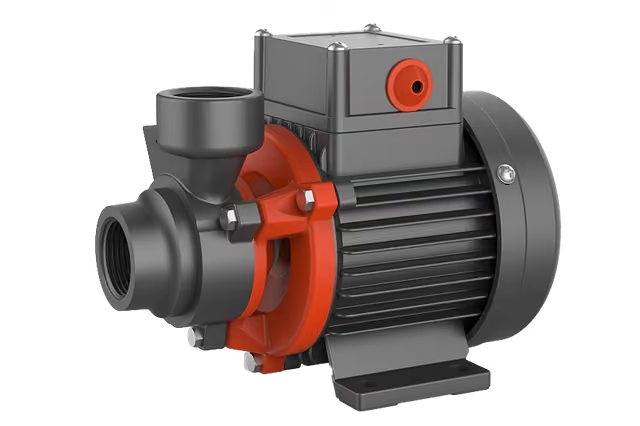
- A peripheral pump gives high pressure at low flow, the right profile for a high tank. The LEO XKM60-1 (40 m maximum head, 40 L/min) leaves a good margin for 15 m. The XKM80-1 (70 m, 60 L/min, 6 m maximum suction), the APM110 (85 m, 70 L/min) and the APM150 (90 m, 80 L/min) give more flow at the same height: useful for a large tank, a long pipe run or a multi-storey building.
- A jet pump is self-priming: on start-up, it clears air from the suction pipe. That helps when the suction pipe is long or can drain, for example when drawing from an underground tank or a shallow well. The LEO AJM75H reaches 50 m of head. As with any self-priming pump, fill its pump body with water before the first start.
Fit two protections: a float switch in the roof tank to stop the pump when it is full, and a float switch or probe in the ground tank to stop it when it is empty. A level controller wired to probes in both tanks does both jobs. A surface pump must never run dry.
Case 3: high flow for several outlets
Large house, small building, big tank to fill quickly: look at flow first.
- The LEO ACM75 centrifugal pump: 0.75 kW, 36 m maximum head, 100 L/min (6.0 m³/h).
- The LEO 2ACM150 multistage pump: 1.5 kW, 55 m maximum head, 130 L/min (7.8 m³/h).
Both have a maximum suction lift of 8 m. Maximum flow and maximum head are never reached at the same time.
Which pump for which case?
Maximum values from our LEO datasheets.
| Your situation | Model | Power | Max head | Max flow |
|---|---|---|---|---|
| Low pressure under a tank | PQ50E-1 (booster) | 0.37 kW | 30 m | 33 L/min |
| Ground tank to a low roof tank | XKM60-1 (peripheral) | 0.37 kW | 40 m | 40 L/min |
| Large tank, long pipe run or several storeys | XKM80-1, APM110, APM150 (peripheral) | 0.75–1.5 kW | 70–90 m | 60–80 L/min |
| Drawing from an underground tank or shallow well | AJM75H (self-priming jet) | 0.75 kW | 50 m | 47 L/min |
| Several outlets, high flow | ACM75, 2ACM150 (centrifugal, multistage) | 0.75–1.5 kW | 36–55 m | 100–130 L/min |
What should you do during power cuts?
During a cut, the roof tank becomes your reserve: water flows down by gravity, and the filling pump only runs to top it up. A booster pump, on the other hand, needs power every time a tap opens.
On a generator, start-up is what counts: a 1.1 kW pump such as the APM110, on direct-on-line start, needs about 4.5 kVA on its own (full calculation in our pump guide). For the whole house, read our guide on power cuts in Kinshasa, then work out your generator size.
Frequently asked questions
Can a booster pump fill a roof tank?
That is not its job. The PQ50E-1 keeps pressure up at the taps. To lift water to a tank, choose a peripheral or jet pump.
Booster pump or peripheral pump: how do I choose?
Is the water already up high but weak at the taps? Booster pump. Does it have to climb from a ground tank to a roof tank? Peripheral pump.
Does a pump help if REGIDESO supplies no water?
Not directly. A pump moves water; it does not create it. Store water in a tank when the mains supplies it, then pump from that tank.
Ask for a quote
Send us the following on WhatsApp at +243 903 005 060: the number of floors, the height of your tank, your water source (mains, ground tank or underground tank) and the number of outlets. Our team will suggest the right pump and can handle its installation and commissioning. MK Energies & Services is an authorized LEO dealer in Kinshasa. Prices on request.
Sources: LEO datasheets published by MK Energies & Services (product pages); La Voix des Sans-Voix, quoted by Radio Okapi on 31 March 2026 (article republished by AllAfrica); calculation method of the MK Energies & Services generator finder.
A question?
Our team answers on WhatsApp or through the contact form.
Products mentioned
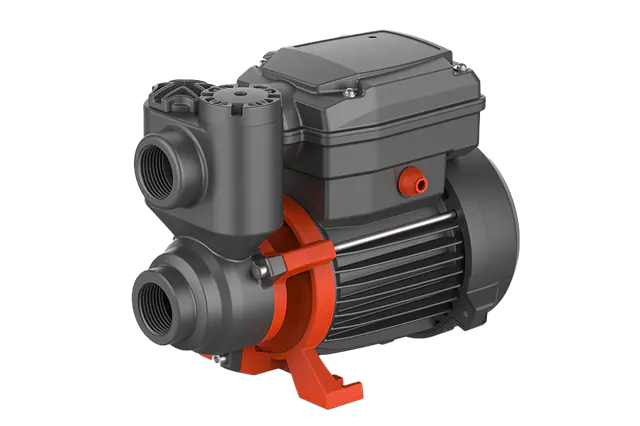
- Max flow
- 33 L/min
- Max head
- 30 m
- Inlet / outlet
- 1"
- Voltage
- 180-220 V / 50 Hz
Price on request
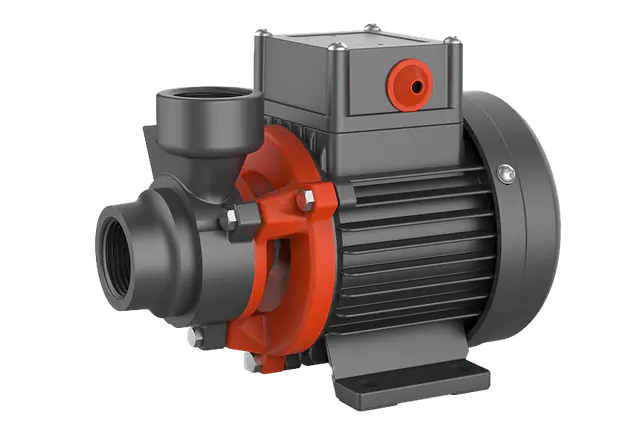
- Max flow
- 40 L/min (2.4 m³/h)
- Max head
- 40 m
- Inlet / outlet
- 1"
- Voltage
- 230 V / 50 Hz
- Single phase
Price on request
- Max flow
- 60 L/min
- Max head
- 70 m
- Inlet / outlet
- 1"
- Voltage
- 230 V / 50 Hz
Price on request
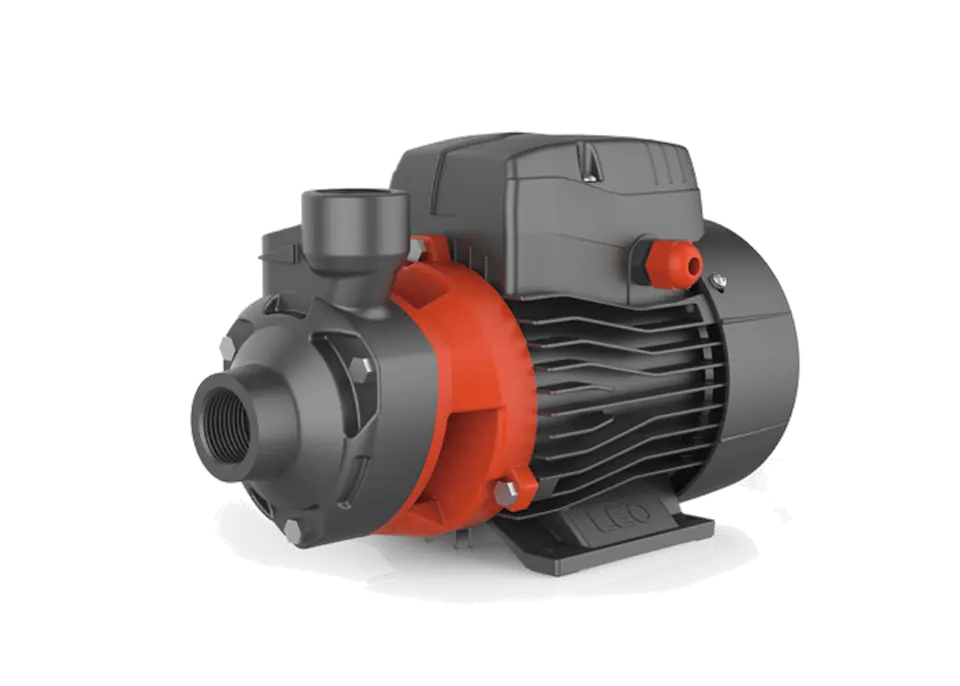
- Max flow
- 4.2 m³/h (70 L/min)
- Max head
- 85 m
- Max suction
- 8 m
- Single phase
- IPX4
Price on request

Related categories